
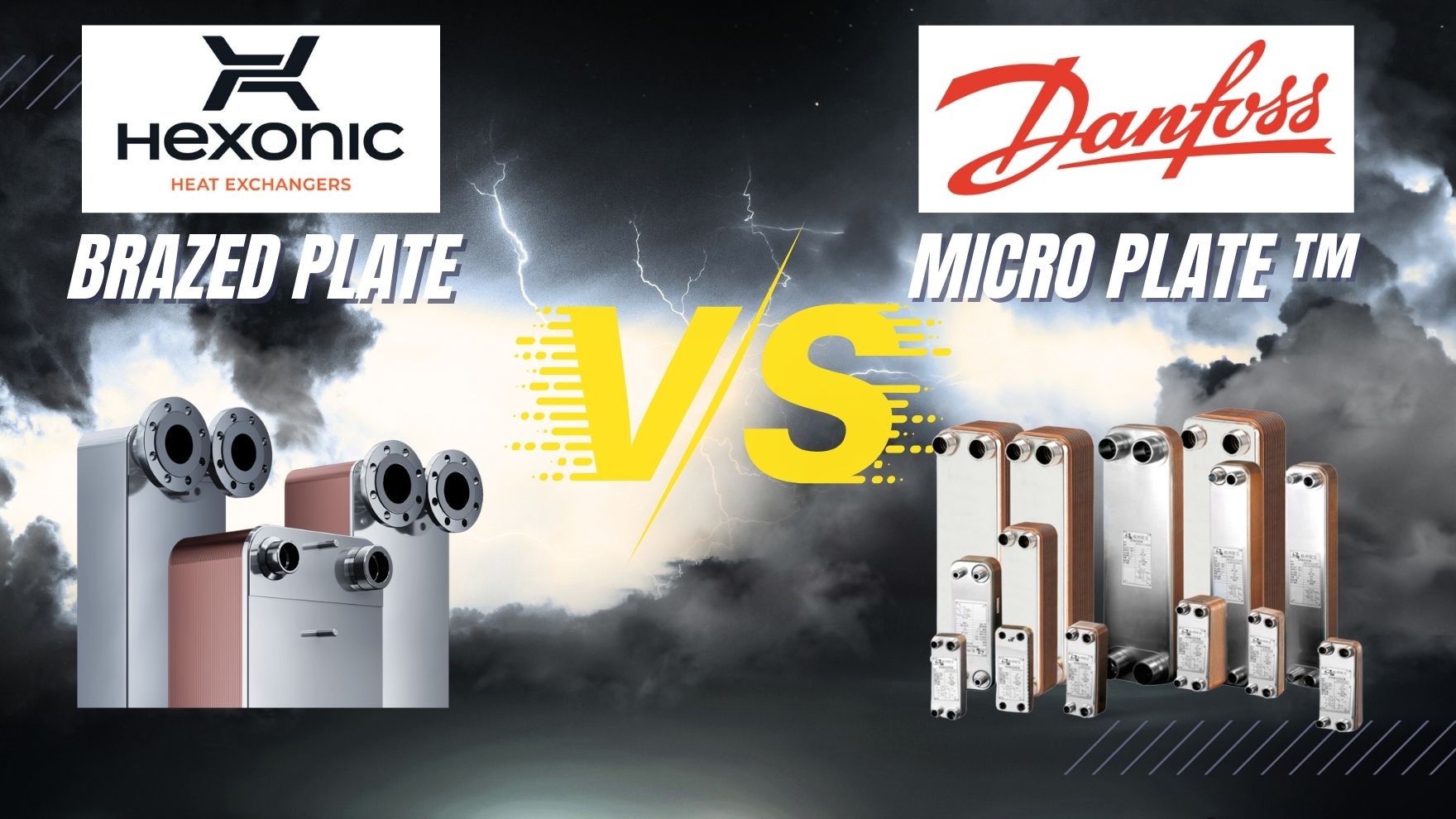
Micro Plate™ or brazed plate heat exchanger? Which type is worth choosing, and when?
A comparison of the heat exchangers most commonly found in Lithuania, made with Micro Plate™ and brazed plate technology.
We are in constant contact with engineers, homeowners' association chairs and companies maintaining heating substations about the choice of heat exchangers. We share the opinion formed from our customers' observations in Lithuania and hope this information will be useful for assessing and making the most suitable decision. The comparison is based on real practice in Lithuania, working with companies maintaining heating substations in different regions.
When is Danfoss Micro Plate™ the most suitable, and when is a Hexonic or other manufacturer's brazed plate heat exchanger? The insights are ours; the choice is yours.
| Feature | Danfoss Micro Plate™ heat exchangers | Hexonic or other manufacturers' brazed heat exchangers |
| Plate shape | Micro profile (unique pattern) | Chevron / herringbone |
| Efficiency at low ΔT | ✅ Higher (suitable for a 3–5 °C difference) | 🛑 Average (optimal at 7–10 °C) |
| Pressure drop | ✅ Lower | 🛑 Higher at high flow rates |
| Heat exchanger size | ✅ Compact design | 🛑 May be larger for the same capacity |
| Suitability for heat pumps | ✅ Excellent | ✅ Suitable, the model must be selected correctly |
| Water requirements | 🛑 High (filtration, softening) | ✅ Adequate for real-world conditions |
| Sensitivity to air bubbles | 🛑 Sensitive | ✅ Much more tolerant |
| Resistance to impurities | 🛑 Clogs faster | ✅ Resistant in systems with corrosion and dirt |
| Maintenance | 🛑 More complex, requires almost ideal operating conditions | ✅ Simple and long-lasting operation |
| Price | 🛑 Higher | ✅ Economical choice |
| Option to change manufacturer | 🛑 Often the same model is required | ✅ Many equivalents on the market |
| Reliability in refurbishments | 🛑 Perfect balancing and water filtration are essential | ✅ A classic technology proven over time |
Danfoss Micro Plate™ heat exchangers are innovative, high-quality modern products. They are an excellent choice for new systems, given the advantages listed above. Nevertheless, practice shows that the new technology also has drawbacks: heat exchangers made with Micro Plate technology are much more sensitive in poorer conditions, and when it comes to apartment buildings, we have to tell customers that the heat exchanger may last for a shorter time, because in many cases the heating substation cannot be supplied with good-quality water; there are no additional filters, automatic air venting or softening solutions, and lower-quality water clogs the smaller heat exchanger channels faster. Danfoss has developed a separate Micro Plate™ CoResist line of heat exchangers designed to work with lower-quality water. They use nickel instead of the usual copper, which makes these heat exchangers more resistant. Nickel brazing, or steel brazing intended for particularly aggressive environments, can be offered by almost all reputable heat exchanger manufacturers.
A Danfoss Micro Plate™ heat exchanger is worth choosing when:
- New systems are being installed and the ΔT is low;
- Almost ideal water quality can be provided at the site, and there is filtration and automatic air removal;
- The highest efficiency and the smallest possible heat exchanger size are required.
A Hexonic (or other manufacturers') brazed heat exchanger is worth choosing when:
- In apartment building heating and domestic hot water production, where a proven solution without excessive technology is needed;
- The water quality is not ideal, when refurbishing an existing system;
- You want a reliable, more resistant and cheaper solution.
Danfoss, SWEP, Alfa Laval, Kaori, Hexonic, Funke, Kelvion and AIC are reliable companies that ensure high quality standards for their products. A properly selected heat exchanger means fewer failures and fewer resident complaints. The final choice should be based on the specific requirements of the system, water quality and maintenance capabilities.
Heat exchangers from every company fail. Instead of "looking for the original", it is worth looking into what unit it was and how many years it ran. Hexonic stands out, offering a more economical solution without compromising on quality. Hexonic can also offer, in its range, various series with connections identical to heat exchangers made by Danfoss, Alfa Laval and others. So let us compare technical parameters, not the logo. After all, you pay for heat transfer, not for an expensive logo that is not even visible, especially as most components, or even the final production, take place in the same factories or in the same region.
If you have to replace the heat exchanger more often than every 2 years, it is worth thinking about a gasketed one. If you have questions or comments, think we are wrong, or need advice, get in touch!

Supplier of building heating substation equipment
This article is based on Amegata.lt's hands-on experience. See it differently or have something to add? Write to us – we're happy to discuss, and if you share new, well-founded information, we will update the article. Updated October 2026.