
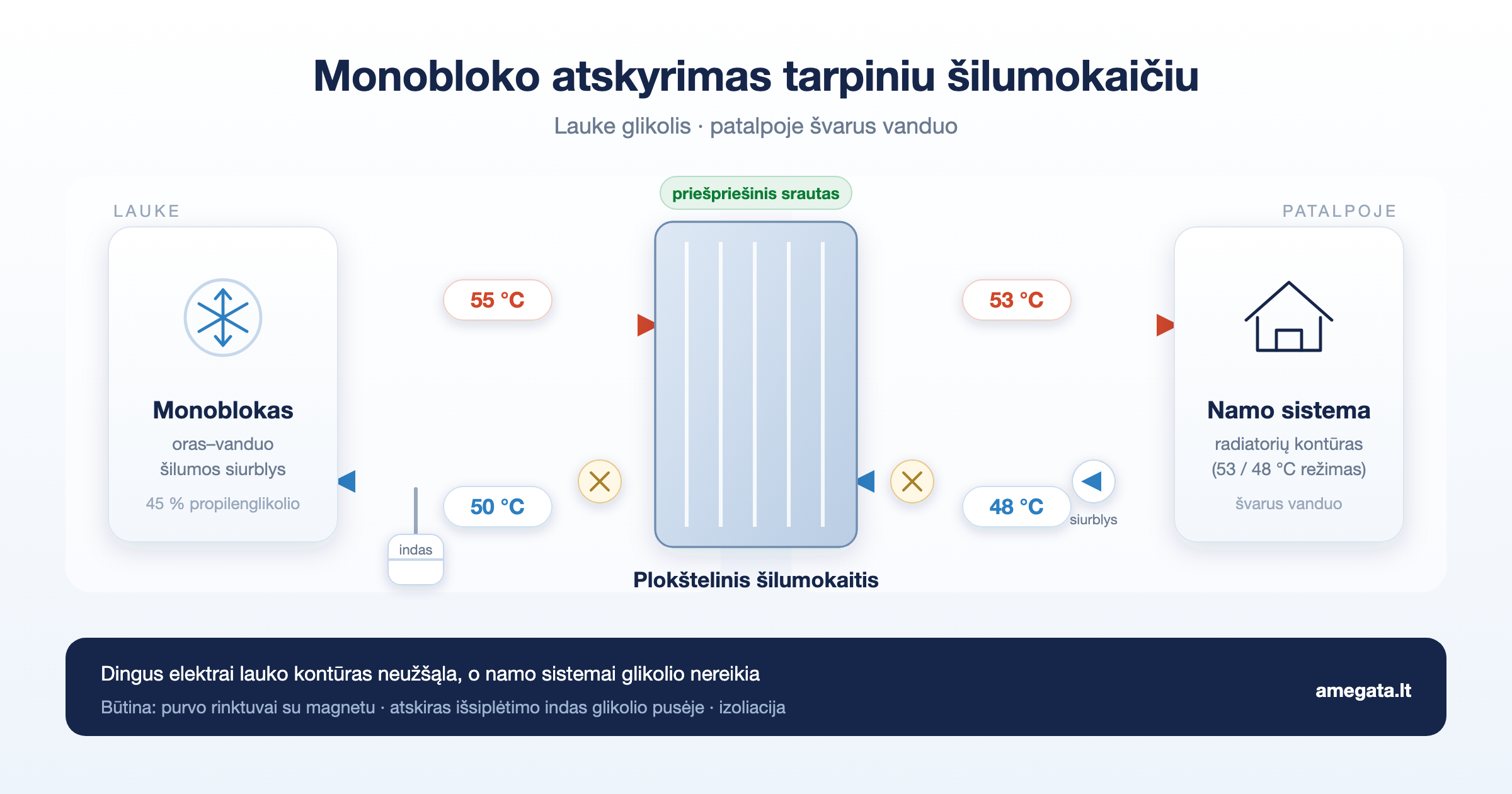
Today the heat pump is the most popular choice for a new or renovated home: state support, quick installation and low running costs. An air-to-water monobloc is especially convenient: all the equipment is assembled in the outdoor unit and there is no need to work with refrigerant lines.
But between that unit and your house there is one component that quietly determines whether the system will run efficiently or eat up electricity every year: the intermediate plate heat exchanger. In Lithuania the outdoor circuit is usually filled with propylene glycol (so that it does not freeze), and it is this heat exchanger that separates it from the water in the house.
In practice there is often debate about what to base the selection on. "By eye" rules, such as the connection diameter alone or a dry kilowatt figure, are misleading. Below are the real engineering criteria that will help you save both money and expensive equipment.
1. Why a monobloc needs an intermediate heat exchanger
- Freeze protection of the outdoor circuit. The concentration is selected according to the lowest design temperature:
For Lithuania's design temperature of −22…−25 °C, 40–45% is realistically needed.Propylene glycol Freezing temperature 35 % about −18 °C 40 % about −22 °C 45 % about −26 °C - Cleanliness and hydraulics of the indoor system. The house circuit stays on water: lower viscosity, lower pump losses, and no need to buy glycol for the whole volume.
2. Four key selection parameters
A. Pressure drop and flow resistance
The heat pump's circulation pump is limited. Excessive internal resistance means the pump will not push through the required flow and the controller will throw a "Low flow" error.
Norm: up to 10–15 kPa (the exact limit is set by the curve of the specific pump).
Example. Two calculations, the same capacity (Hexonic CAIRO). Only the closeness of the temperatures between the circuits differs:
| Large difference LMTD 7.2 °C |
Small difference LMTD 2.0 °C |
|
|---|---|---|
| Glycol | 35 % PG | 45 % PG |
| Primary circuit | 60 → 55 °C | 55 → 50 °C |
| Secondary circuit | 45 → 55 °C | 48 → 53 °C |
| LMTD | 7.2 °C | 2.0 °C |
| Fouling factor | 0 | 0.0177 m²K/kW |
| Selected model | LB31-40H-1" cat. 0203-0639 |
LB31-50H-1" cat. 0203-0640 |
| Heat transfer area | 1.2 m² | 1.7 m² |
| Pressure drop | 5.8 / 1.2 kPa | 7.0 / 4.9 kPa |
| Capacity margin | +64.9 % | +8.7 % |
The same capacity, the same product family, but in the second case a 42% larger area is needed, and the margin drops from 65% to 9%.
What decides it is not the application but the LMTD. The second example is a high-temperature, low-lift mode: the glycol is at 55 °C and the water must be heated to 53 °C, so the circuits almost converge. Underfloor heating with the same 55 °C glycol, with the secondary circuit at 30 → 35 °C, would conversely have a huge margin, because the difference between the circuits is large.
Calculations from saved project EU.25.09.000450, calculation EU2605000237.002 (2026-09-22).
This is where the most expensive mistake is made. If you take a calculation made for a large temperature difference and apply it to a low-lift mode, the heat exchanger will be too small. The system will work, but the heat pump will constantly raise the temperature higher than necessary; the electricity bill will grow all season, and since there is no failure, nobody will look for the cause.
Also pay attention to the fouling factor: in the first calculation it is zero, in the second it is realistic. A new system is always calculated with a margin for deposits; otherwise, after a few years the selection is no longer valid.
B. Number of plates and heat transfer area
A common mistake is too few plates: the flow forces its way through a few narrow gaps, pressure and velocity spike, noise appears and erosion speeds up. A larger number of plates reduces the velocity between the plates to a uniform level (0.19 and 0.15 m/s in the examples) and gives a capacity margin.
C. Temperature difference and COP
Heat pumps are low-temperature equipment: every additional degree the pump is forced to raise reduces the COP.
The goal is the smallest possible difference between the glycol and water circuits, in practice 2–4 °C. An even smaller difference is possible, but it requires an extremely large area and becomes sensitive to fouling: once heat transfer deteriorates due to deposits, there is no reserve left.
D. Glycol viscosity
Propylene glycol has a higher viscosity and a lower heat capacity than water, so heat transfer worsens and hydraulic resistance grows.
Rule: with 30–40% glycol, choose an area 15–20% larger than for a "water–water" system.
3. Connection diameter: a myth versus the whole picture
There is a belief on the market that you must choose only connections of a certain diameter, 5/4" or 6/4". But the connection is only one component of the hydraulics.
With enough plates and volume, the fluid in the connections reaches a safe velocity (in the first example 1.87 m/s, in the second 1.90 m/s on the glycol side), without noise, erosion or pressure spikes. You need to assess the whole geometry and carry out the calculation with software, rather than relying on the thread size.
4. Practical installation rules
- Counter-flow. Glycol and water must flow in opposite directions. Connecting them in parallel loses up to 30% of efficiency, and from the outside everything looks fine; the error is visible only when measuring temperatures.
- Mechanical filtration. Upstream of the heat exchanger, fit a dirt separator with a magnetic insert. The gaps between the plates are small, and magnetite from an old system irreversibly degrades heat transfer.
- Accessories and insulation. A closed glycol circuit must have its own safety group and expansion vessel, and the heat exchanger is covered with an insulation shell (EPP or APFI).
Frequently asked questions
What pressure drop is acceptable in a monobloc's intermediate heat exchanger?
It is recommended not to exceed 10–15 kPa. The circulation pump then pushes through the required flow without excess electricity use, and the controller does not throw a flow error. The exact limit is set by the characteristic of the specific pump.
What glycol concentration is needed for Lithuania?
It depends on the lowest design temperature: 35% protects down to roughly −18 °C, 40% to −22 °C, 45% to −26 °C. Most sites in Lithuania need 40–45%. In practice, customers often calculate with only 35%, and in our view that is too little for a Lithuanian winter: −18 °C is not enough, and in a cold snap the outdoor circuit enters the risk zone (Low flow, shutdown). This is one of the most common silent mistakes.
How much larger a heat exchanger is needed when using glycol?
With a 30–40% propylene glycol solution, the area is selected about 15–20% larger than for a system with water, because of the higher viscosity and lower heat capacity.
Why is the same heat exchanger suitable in one project but not in another?
Everything is determined by how close the temperatures of the circuits are (LMTD), not by the application. When the glycol is at 55 °C and the water must be heated to 53 °C, the difference is only 2 °C and a large area is needed. When the same glycol heats an underfloor circuit to 35 °C, the difference is large and a considerably smaller heat exchanger is enough. So a selection cannot be carried over from one project to another.
Is it enough to choose by connection size?
No. The connection is only one component of the hydraulics. What decides it is the whole geometry (number of plates, dimensions and connections) and a software calculation.
How much is lost by connecting in parallel flow?
Up to 30% of the heat exchanger's efficiency. A plate heat exchanger must be connected in counter-flow.
You can find Hexonic LB31, LB60 and LC110 brazed plate heat exchangers and insulation shells in the category Heat exchangers for heat pumps and monoblocs.
Need help?
Fill in the form below, giving the capacity, the temperatures of both circuits and the glycol concentration, and within a few minutes we will carry out the calculation and propose the most suitable Hexonic or other heat exchanger, with the price and delivery time. We reply to enquiries within one working day at the latest. Telephone consultations: +370 651 11191
This article is based on Amegata.lt's hands-on experience. See it differently or have something to add? Write to us – we're happy to discuss, and if you share new, well-founded information, we will update the article. Updated October 2026.