
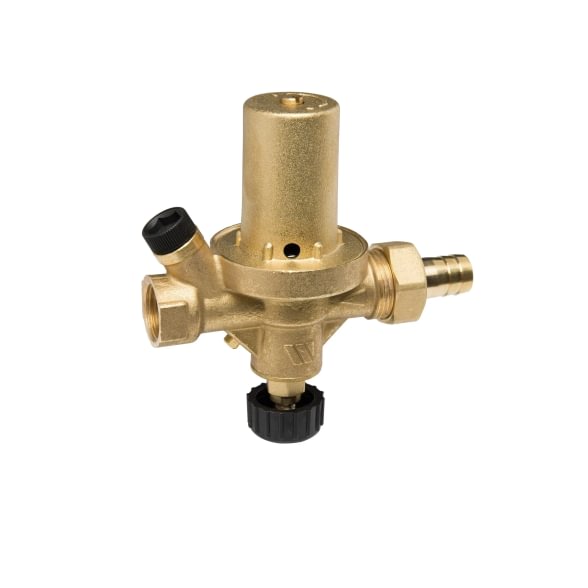
Watts 146-1/2 automatic filling valve (ALD equivalent)
- Function: make-up + pressure reducer in one device
- Connection: 1/2" internal thread (both sides)
- Secondary pressure range: adjustable (typically 0.5-4 bar)
- With gauge: visual secondary pressure indication
Where Watts 146-1/2 is used
Standard component in the make-up line of closed heating systems. Installed between the potable water main and the expansion vessel or return line of the heating system. Task: when system pressure drops below the setpoint (natural water losses through air vents, microleaks, thermodynamic changes) — automatically opens make-up until the set secondary pressure is reached. When system pressure recovers — the valve closes.
Technical specifications
| Parameter | Value |
|---|---|
| Code | 10004877 |
| Model | Watts 146-1/2 (ALD equivalent) |
| Type | Automatic make-up valve with pressure reducer |
| Connection | 1/2" internal thread (inlet and outlet) |
| Primary (supply) pressure | up to 16 bar |
| Secondary pressure (adjustable) | 0.5-4 bar (see Watts catalogue for exact range) |
| Gauge | Integrated, 0-6 bar or equivalent |
| Max working temperature | 40 °C (potable water side) |
| Media | Potable water |
| Body material | Brass |
How the valve works
A diaphragm separates the primary (supply) and secondary (heating) sides. When secondary pressure drops below the setpoint, the spring opens the diaphragm — water flows into the system. When secondary pressure reaches the setpoint — the diaphragm automatically closes. Pressure control performs two tasks in one: (1) makes up lost water, (2) protects the heating system from potable water main overpressure (typically 4-6 bar in city networks, while heating only needs 1-2 bar).
When to choose Watts 146-1/2
- Domestic heating systems (house, apartment) with light make-up demand
- Small commercial boiler room make-up point
- ALD equivalent — when replacing an old valve with the same connection
- Systems where visual pressure indication (integrated gauge) is desirable
B2B delivery and logistics via Amegata.lt
- 24-hour delivery across the EU (from our warehouse in Vilnius)
- Competitive B2B pricing — often below market average
- 30-day payment terms for companies (per contract)
- Free technical consultation for valve sizing
Official Watts catalogue: wattswater.eu
Frequently asked questions
What secondary pressure setting should I choose?
Depends on system height and expansion vessel precharge. Rule of thumb: make-up pressure = expansion vessel precharge + 0.3 bar. Single-dwelling system — typically 1.0-1.5 bar. High-rise buildings may require 2-3 bar.
Is a filter needed upstream of the valve?
Recommended. Potable water debris (rust, scale) shortens diaphragm and seat life. Install a Y-strainer (min. 500 μm) and a shut-off ball valve upstream — for maintenance access.
How do I know the valve is working correctly?
System pressure (visible on the integrated gauge) should be stable (0.1-0.2 bar fluctuation over the day is normal). If pressure keeps rising — the valve is not sealing (leaks from potable to heating side). If pressure keeps falling and the valve does not top up — either the system has a leak, or the valve is clogged.
How does it differ from a plain pressure reducer?
A plain pressure reducer only regulates pressure — it allows continuous flow. A make-up valve opens only when secondary pressure drops below the setpoint, and closes again once the target is reached. Suited to closed loops where continuous flow is not required.