
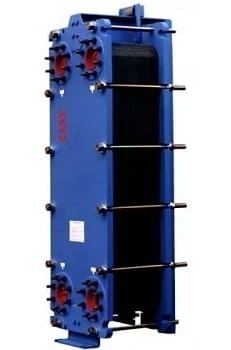
Hexonic FA-004-P16-2S-71H gasketed plate heat exchanger, DN32, 71 plates, PN 16
- Application: primary/secondary loop separation — district heating, DHW, heating, cooling
- Heat capacity: ~87-157 kW per section (plate pack split between two duties)
- Nominal pressure: PN 16 (16 bar); frame design pressure up to 25 bar
- Connection: G 1 1/4" external thread (DN32)
Where FA-004-P16-2S-71H is used
Compact 2-section frame — one housing for two duties (saves boiler-room floor space). The gasketed / framed construction allows future capacity expansion by adding plates to the same frame or cleaning off fouling without replacing the unit — important for long-term operation in multi-family and commercial substations. Plates are 316L (1.4404) stainless steel, resistant to municipal district heating water. Gaskets are EPDM (glued or clip-on depending on plate type), suitable for water up to +150 °C.
Technical specifications
| Parameter | Value |
|---|---|
| SKU | A1S-P16-71-H |
| Series | Hexonic FA-004 / A1S |
| Model | FA-004-P16-2S-71H |
| Construction | Gasketed / framed — bolted plate pack with elastomer gaskets |
| Number of plates | 71 |
| Plate profile | "H" (high chevron angle — higher heat transfer coefficient) |
| Loop configuration | Two-section (2S) — two independent duties in one frame |
| Nominal pressure (PN) | 16 bar (frame design up to 25 bar) |
| Max operating temperature | +150 °C (EPDM gaskets) |
| Connection | G 1 1/4" external thread (DN32) |
| Plate material | Stainless steel 316L / 1.4404 (304L available on request) |
| Gaskets | EPDM (standard); NBR or FKM/Viton available |
| Frame | Carbon steel, powder-coated |
| Frame length | ~493 mm |
| Standards | PED 2014/68/EU |
Heat transfer capacity — quick calculation
Capacity depends on flow rate, ΔT and logarithmic mean temperature difference (LMTD). General formula: P = Q × ΔT × 1.163 (P — kW, Q — m³/h, ΔT — °C).
Example for heating mode (primary 90/70 °C → secondary 65/40 °C): at Q = 5 m³/h and effective ΔT ≈ 20 °C → P ≈ 116 kW. This 71-plate pack typically delivers ~87-157 kW per section (plate pack split between two duties).
When to choose FA-004-P16-2S-71H
- Combined heating + DHW substations — both duties in one frame
- Two-loop separation in modular substation skids
- DHW primary + secondary in a single unit (when double separation is required)
- Commercial sites with tight boiler-room footprint constraints
B2B delivery and logistics via Amegata.lt
- Delivery within 2-5 business days across Lithuania (made-to-order from manufacturer)
- Competitive B2B pricing — often below market average
- 30-day payment terms for companies (per contract)
- Free technical consultation for sizing (Cairo calculations)
- Spare gaskets and plates — can be ordered together
Official Hexonic catalogue: hexonic.com/F-series (JAG F / F)
Frequently asked questions
What does "H" mean in FA-004-P16-2S-71H?
"H" denotes a high chevron angle on the plate (high theta) — higher heat transfer coefficient but higher pressure drop. Some Hexonic frames also offer "L" (low chevron, lower Δp) or mixed packs (H+L) — we select the mix to fit your flow rate and Δp budget.
Can glycol mixtures be used?
Yes. 316L plates and EPDM gaskets are compatible with ethylene glycol and propylene glycol solutions up to 50 %, with proper inhibitors. For DHW — only potable-grade fluids.
What maintenance is required?
The gasketed construction allows periodic plate cleaning (CIP or mechanical) when fouling appears. Gaskets should be replaced every 5-7 years or earlier if leakage is detected. For comparison: brazed exchangers have no gasket maintenance — but plates cannot be cleaned or added either.
When to choose gasketed vs brazed?
Gasketed — when you need the ability to clean off fouling (hard water, commercial systems), change capacity (add plates in pack) or when gasket maintenance is acceptable. Brazed — when you need low weight, compact housing and a "fit and forget" solution (without capacity expansion).
Is it suitable for regions with aggressive water?
In some Lithuanian regions, district heating water contains elevated chlorides or ammonia — 316L (standard plates) is suitable in most cases, but for very aggressive water we recommend titanium plates (available on request). For hard water with elevated Ca/Mg carbonate content, limescale gradually builds up on the plates and reduces heat-transfer efficiency; for such systems gasketed (plate-and-frame) exchangers are preferable, as they can be periodically opened for mechanical or CIP cleaning. Contact us — we will select the model best suited to your water conditions.
How much boiler-room space does it need?
This frame is approximately ~493 mm. You will need free floor space equal to the frame length on one side to loosen the tie bolts and slide out plates for maintenance. Plan this into your boiler-room layout.
