
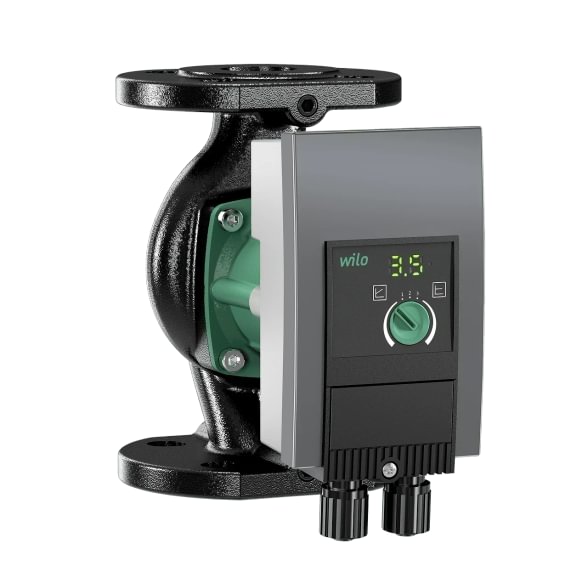
Wilo Yonos MAXO 40/0.5-8 circulator pump (220 mm)
- Application: heating circulation
- Q × H: up to 12.0 m³/h × 8.0 m
- Power / P1 max: 1×230 V / 230 W
- DN + PN: DN40 (DN40 flanšas (PN 6/10)), PN 6/10
Where Yonos MAXO 40/0,5-8 is used
DN40 flanged model with 8 m head — for multi-family heating, medium substations, commercial building HVAC.
The pump handles water and water–glycol mixtures up to 50 % (viscosity impact to be accounted for). Control modes: Δp-c, Δp-v, n = const. Liquid temperature range: -10 °C … +110 °C.
Technical specifications
| Parameter | Value |
|---|---|
| Model | Yonos MAXO 40/0,5-8 |
| Manufacturer code | 2120646 |
| Connection | DN40 flanšas (PN 6/10) (DN40) |
| Max. working pressure (PN) | 6/10 bar |
| Max. flow (Q) | 12.0 m³/h |
| Max. head (H) | 8.0 m |
| P1 power | 12–230 W |
| Power supply | 1×230 V / 50 Hz |
| Enclosure class | IPX4D |
| Energy Efficiency Index (EEI) | ≤ 0.20 (Class A) |
| Control modes | Δp-c, Δp-v, n = const |
| Liquid T range | -10 °C … +110 °C |
| Port-to-port length | 220 mm |
| Weight | ~8.4 kg |
Sizing formula — quick calculation
Required flow rate: Q = P / (1.163 × ΔT), where P – heating load (kW), ΔT – supply/return temperature difference (°C).
Example: a 20 kW system with ΔT 15 °C requires Q = 20 / (1.163 × 15) = 1.15 m³/h. Wilo Yonos MAXO 40/0,5-8 fully covers up to ~100 kW systems.
When to choose Yonos MAXO 40/0,5-8
- Single-family homes / townhouses with radiator or mixed heating
- Substation secondary circuits (up to ~100 kW)
- Townhouse complexes, small commercial HVAC systems
- Renovation projects requiring a Wilo / Grundfos analog without piping rework
- Compatibility / replaces: Wilo Stratos 40/1-8, Grundfos MAGNA1 40-80 F, older UPS-D 40-60/80.
B2B delivery and logistics via Amegata.lt
- Next-day delivery across Lithuania (from Vilnius warehouse)
- Competitive B2B pricing — often below market average
- 30-day payment terms for verified companies
- Free engineering consultation on pump selection
Official Wilo catalogue: wilo.com
Frequently asked questions
What is the difference between Δp-c and Δp-v control modes?
Δp-c (constant pressure) keeps a fixed differential pressure across the system, better suited to underfloor heating or systems without thermostatic valves. Δp-v (proportional pressure) lowers the differential as flow drops, better for radiator systems with thermovalves.
Is it suitable for open-vented heating systems?
No — Yonos MAXO 40/0,5-8 is designed for closed pressurised systems. Open-vented gravity-flow systems require a different pump type.
Does it work with glycol?
Yes, up to 50 % water–glycol concentration. Viscosity impact must be accounted for — real head typically drops about 10–15 % with 30 % glycol, and P1 power shifts accordingly.
What is the typical EEI class and why does it matter?
Wilo Yonos MAXO 40/0,5-8 meets the Ecodesign (≤ 0.20 (Class A)) requirement. Compared to older 3-speed pumps, ECM motors consume up to 80 % less electricity under partial load — a significant benefit for long-term operation.
What is the recommended installation position?
Horizontal rotor shaft, cable entry facing down or sideways. Vertical mounting is not allowed. Install a strainer/filter upstream — pumps do not tolerate welding slag or debris in new systems.


