
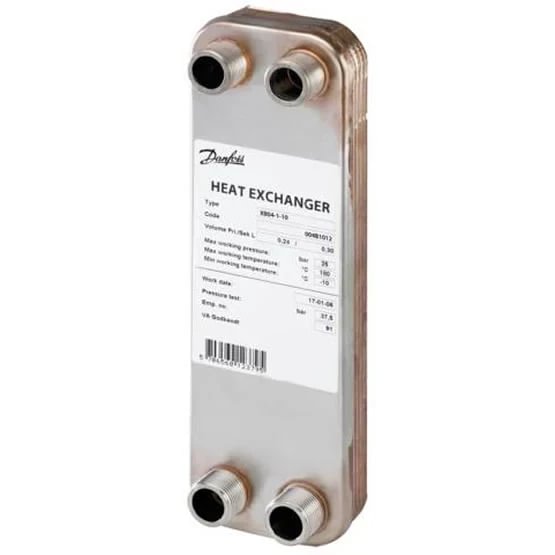
Danfoss XB12M-1 30 CoResist brazed plate heat exchanger, G 1¼", 30 plates, PN 25
- Application: heating loop separation in aggressive DH water
- Plates: 30 pcs, "M" corrugation (medium chevron angle)
- Nominal pressure: PN 25 (25 bar)
- Connection: G 1¼" external thread (DIN ISO 228/1)
Where XB12M-1 30 CoResist is used
This 30-plate exchanger is designed for substation primary/secondary loop separation when district heating water contains elevated chlorides or ammonia. In such water the service life of a copper-brazed exchanger may be shorter; Danfoss classifies CoResist (Cu+) brazing as medium corrosion resistance. "M" plate geometry balances heat transfer and pressure drop — a universal choice for heating branches. For hard water with elevated Ca/Mg carbonate content, limescale gradually builds up on the plates and reduces heat-transfer efficiency; for such systems gasketed (plate-and-frame) exchangers are preferable, as they can be periodically opened for mechanical or CIP cleaning.
Technical specifications
| Parameter | Value |
|---|---|
| Code | 079G1351 |
| Series | Danfoss XB12 Micro Plate |
| Model | XB12M-1 30 CoResist |
| Number of plates | 30 |
| Plate type | "M" (medium chevron angle) |
| Number of passes | 1-pass (4 connections) |
| Nominal pressure (PN) | 25 bar |
| Temperature range | −10 … +180 °C |
| Connection | G 1¼" external thread (DIN ISO 228/1) |
| Plate material | Stainless steel EN 1.4404 (AISI 316L) |
| Brazing filler | CoResist (Cu+) — Danfoss: medium corrosion resistance brazing type |
| Volume per channel | 0.035 L |
| Dimensions (H × W × D) | 289 × 118 × 52 mm |
| Weight | ~3.85 kg |
| Construction | Brazed, hermetic (gasket-free) |
| Media | DH circulation water, glycol solutions up to 50% |
Heat transfer capacity — quick calculation
Capacity depends on flow rate, ΔT and LMTD. General formula: P = Q × ΔT × 1.163 (kW, Q m³/h, ΔT °C).
Illustrative calculation, not this model's capacity. Example for heating mode (primary 90/70 °C → secondary 65/40 °C): at Q = 1.5 m³/h and effective ΔT ≈ 20 °C → P ≈ 35 kW. With Q = 2.0 m³/h and ΔT ≈ 22 °C → P ≈ 51 kW. Size accurately via Danfoss Hexact.
When to choose XB12M-1 30 CoResist
- Substations with elevated Cl⁻ or ammonia in DH water
- Retrofits where copper-brazed exchangers have leaked earlier
- When extended service life in aggressive DH water is required
B2B delivery and logistics via Amegata.lt
- 24-hour delivery across Lithuania (from our warehouse in Vilnius)
- Competitive B2B pricing — often below market average
- 30-day payment terms for companies (per contract)
- Free technical consultation on water quality and sizing
Frequently asked questions
When to choose CoResist vs. standard copper brazing?
The main criterion is how aggressive the DH water is (chlorides, ammonia). Danfoss: Cu brazing is for clean, non-corrosive liquids, CoResist is medium corrosion resistance. Check specific limits (e.g. chloride concentration) with Danfoss technical support or contact us. For hard water with elevated Ca/Mg carbonate content, limescale gradually builds up on the plates and reduces heat-transfer efficiency; for such systems gasketed (plate-and-frame) exchangers are preferable, as they can be periodically opened for mechanical or CIP cleaning.
How do I find out my DH network water composition?
Three routes: (1) ask the DH provider — many publish periodic water quality reports; (2) inspect the previous exchanger at the site (weeping or "red" deposits indicate aggressive water); (3) order an independent lab analysis — a certified lab will return Cl⁻, NH₃, pH and hardness results within 3-5 business days.
Is XB12M-1 30 CoResist suitable for domestic hot water (DHW)?
1-pass (4-connection) models suit heating loop separation. Danfoss states that 6-connection two-pass exchangers are primarily used for heating domestic hot water. If you need DHW - contact us and we will recommend a suitable model.
Is it suitable for potable water systems?
Plates are AISI 316L (1.4404). The Danfoss XB certificate list includes SVGW, Kiwa and PZH drinking-water hygiene certificates (not valid for every code); verify the specific code against the Danfoss certificate list.


