
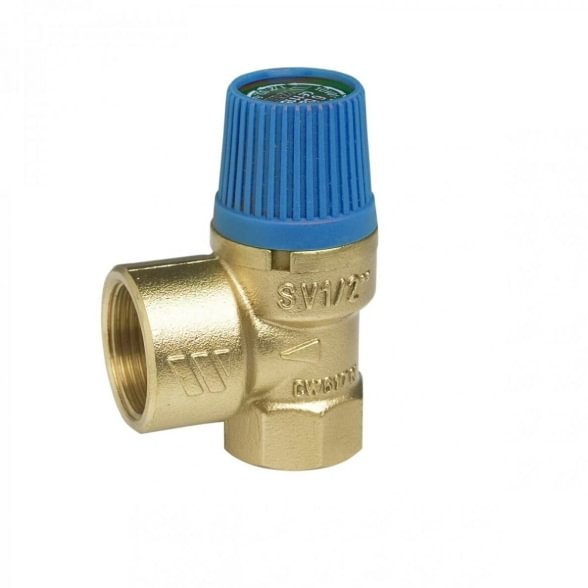
Watts SVW 6 3/4" apsauginis vožtuvas
- Opening pressure: 6 bar (fixed, factory sealed)
- Inlet connection: 3/4" internal thread (female)
- Certification: TÜV per DIN EN 1268 / DIN EN ISO 4126
- Media: heating system water, up to 30 % glycol
Where Watts SVW 6 3/4" is used
Standard safety relief valve for closed heating systems designed for up to 6 bar working pressure — domestic gas/solid fuel boilers, heat pumps, solar collector primary loops, buffer tanks. Installed at the boiler, expansion vessel supply branch, or directly on the heat generator, following manufacturer instructions and the Pressure Equipment Directive PED 2014/68/EU.
Technical specifications
| Parameter | Value |
|---|---|
| Code | 10004724 |
| Series | Watts SVW |
| Type | Diaphragm safety relief valve (closed systems) |
| Opening pressure | 6 bar |
| Inlet thread | 3/4" (internal) |
| Outlet thread | 1" (internal) |
| Max working temperature | 120 °C |
| Media | Heating system water, glycol solution up to 30 % |
| Body material | DZR brass (dezincification-resistant) |
| Diaphragm | EPDM |
| Certification | TÜV, DIN EN 1268, PED 2014/68/EU |
| Installation position | Vertical, spring upwards |
Sizing by boiler output
Safety valve size is chosen not by Kvs, but by heat generator output and manufacturer instructions. Watts SVW 6 3/4" (outlet 1") per DIN 4751 typically suits boilers up to ~100 kW in closed systems with 6 bar design pressure. Confirm the exact match against the boiler manufacturer instruction and the Watts catalogue capacity table.
When to choose SVW 6 3/4" over other variants
- Closed heating systems with design pressure up to 6 bar (typically single-dwelling or small multi-family boiler rooms)
- Boilers with output up to ~100 kW (3/4" inlet with 1" outlet)
- When a TÜV-certified solution is required (mandatory in commercial installations)
- When full dezincification resistance (DZR brass) matters due to water quality
For higher design pressure systems choose SVW 8 3/4" (10004726) — 8 bar opening pressure version. For higher flow capacity — SVW 6 1" (10004749).
B2B delivery and logistics via Amegata.lt
- 24-hour delivery across the EU (from our warehouse in Vilnius)
- Competitive B2B pricing — often below market average
- 30-day payment terms for companies (per contract)
- Free technical consultation for valve sizing
Official Watts catalogue: wattswater.eu
Frequently asked questions
Can the opening pressure be adjusted?
No. SVW series valves are factory sealed and calibrated. Any attempt to adjust voids the certification and manufacturer warranty. If a different pressure setting is required, switch to the appropriate rated model (e.g. SVW 8 = 8 bar).
How often should the safety valve be replaced?
Annual functional test is recommended (manual opening via lever — system pressure should recover without leaks). Replacement — when leaks are visible, seat scaling appears, or after 10-15 years of service (depending on system water quality).
Can it be used for cold water / DHW cylinders?
No. SVW series is designed for closed heating systems only. For DHW cylinders choose dedicated DHW safety valves (Watts SVE or equivalents) — they have different hydraulic properties and certifications.
Is a dedicated drain required?
Yes. The safety valve discharge must connect to a visible, open drain (tundish or plain discharge with an air gap) so persistent leakage is detectable. Enclosed drainage is prohibited under EN 12828.


