
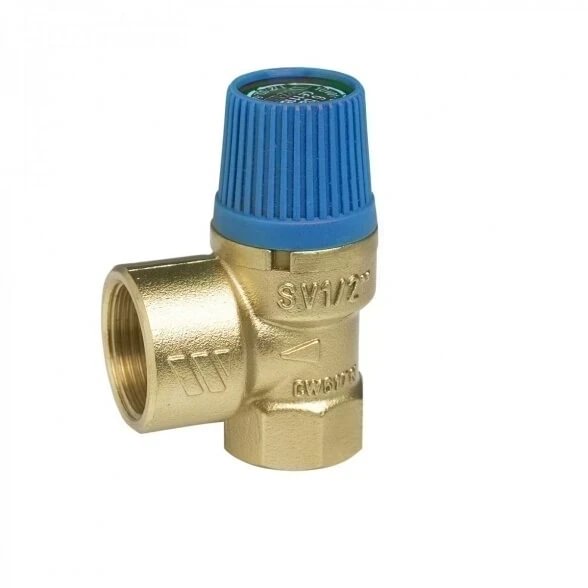
Watts SVW 8 3/4" apsauginis vožtuvas
- Opening pressure: 8 bar (fixed, factory sealed)
- Inlet connection: 3/4" internal thread
- Certification: TÜV per DIN EN 1268 / DIN EN ISO 4126
- Media: heating system water, up to 30 % glycol
Where Watts SVW 8 3/4" is used
Watts SVW 8 is designed for closed heating systems with higher design pressure — high-rise residential blocks, commercial buildings, substation consumer sides where hydrostatic pressure exceeds 4-5 bar and a standard 6 bar valve does not provide adequate margin. 3/4" inlet suits small-to-medium load; 1" outlet gives sufficient drain cross-section for sudden overpressure events.
Technical specifications
| Parameter | Value |
|---|---|
| Code | 10004726 |
| Series | Watts SVW |
| Type | Diaphragm safety relief valve (closed systems) |
| Opening pressure | 8 bar |
| Inlet thread | 3/4" (internal) |
| Outlet thread | 1" (internal) |
| Max working temperature | 120 °C |
| Media | Heating system water, glycol solution up to 30 % |
| Body material | DZR brass |
| Diaphragm | EPDM |
| Certification | TÜV, DIN EN 1268, PED 2014/68/EU |
| Installation position | Vertical, spring upwards |
Sizing by boiler output
Suitability depends on heat generator output and system design pressure. Watts SVW 8 3/4" per DIN 4751 typically covers boilers up to ~100 kW in closed systems designed for up to 10 bar. For higher-load buildings (multi-family with central boiler room) choose SVW 8 1" — larger discharge cross-section covers up to ~150 kW.
When to choose SVW 8 over SVW 6
- Multi-family buildings with elevated hydrostatic column (high-rise blocks where static head exceeds 4 bar)
- Commercial buildings with design pressure up to 10 bar
- Substation consumer side where the secondary circuit is designed for higher working pressure
- When wider margin between working and opening pressure is required (e.g. frequent boiler modulation spikes)
B2B delivery and logistics via Amegata.lt
- 24-hour delivery across the EU (from our warehouse in Vilnius)
- Competitive B2B pricing — often below market average
- 30-day payment terms for companies (per contract)
- Free technical consultation for valve sizing
Official Watts catalogue: wattswater.eu
Frequently asked questions
What is the difference between SVW 6 and SVW 8?
Only the opening pressure: SVW 6 = 6 bar (domestic boilers up to 6 bar systems), SVW 8 = 8 bar (commercial or high-rise buildings up to 10 bar). Construction, thread, body material — identical.
Can it be used with an expansion vessel precharged at 3 bar?
Yes, if the expansion vessel and boiler are rated for at least 8 bar working pressure. In practice SVW 8 is often chosen when expansion vessel precharge exceeds 3 bar — a 6 bar valve then leaves insufficient margin above the normal operating pressure rise.
What causes SVW 8 malfunction?
Most common — mineral deposits on the seat from repeated actuation, or corrosion in a valve that has never operated. Prevention: annual manual opening test (lever pulled fully).
Is SVW 8 suitable for solar collector systems?
Standard SVW 8 suits only the secondary solar loop (buffer side). The primary (collector) loop, where temperatures exceed 150 °C, requires dedicated solar safety valves (high-temperature diaphragms, extended temperature range).

