
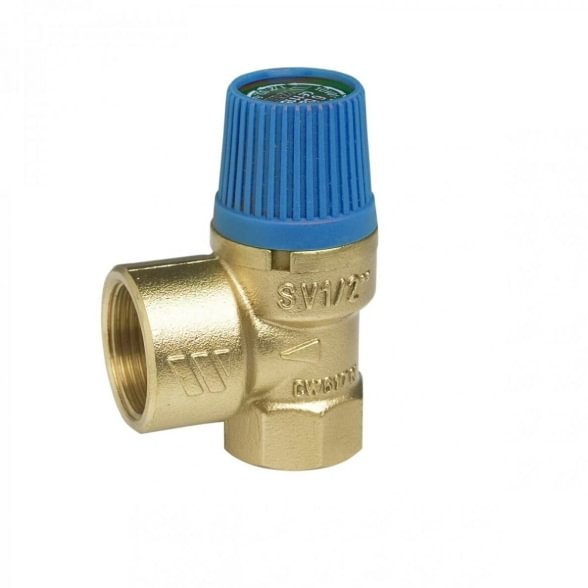
Watts SVW 8 1" apsauginis vožtuvas
- Opening pressure: 8 bar (fixed)
- Inlet connection: 1" internal thread
- Certification: TÜV per DIN EN 1268
- Typical boiler output: up to ~200 kW (per DIN 4751 table at 8 bar)
Where Watts SVW 8 1" is used
For high-rise residential blocks and commercial buildings with heating systems designed up to 10 bar. Typical cases — 10+ storey buildings with central boiler rooms where the hydrostatic column alone reaches 5-6 bar; industrial buildings with high-temperature heating; district-connected systems with elevated working pressure. 1" inlet minimises pressure drop across the valve and ensures fast response at the opening point.
Technical specifications
| Parameter | Value |
|---|---|
| Code | 10004751 |
| Series | Watts SVW |
| Type | Diaphragm safety relief valve (closed systems) |
| Opening pressure | 8 bar |
| Inlet thread | 1" (internal) |
| Outlet thread | 1 1/4" (internal) |
| Max working temperature | 120 °C |
| Media | Heating system water, glycol solution up to 30 % |
| Body material | DZR brass |
| Diaphragm | EPDM |
| Certification | TÜV, DIN EN 1268, PED 2014/68/EU |
| Installation position | Vertical, spring upwards |
Sizing by boiler output
Watts SVW 8 1" per DIN 4751 typically covers up to ~200 kW generator output at 8 bar opening pressure. Higher loads require a specialised safety valve group or a larger DN valve (e.g. SVW 8 1 1/4" — larger model in the same series).
When to choose SVW 8 1" over other versions
- High-rise residential blocks (10+ storeys) with central boiler rooms
- Commercial/industrial buildings with 8-10 bar design pressure
- District heating systems with elevated working pressure
- When 8 bar margin and higher discharge capacity are both required
B2B delivery and logistics via Amegata.lt
- 24-hour delivery across the EU (from our warehouse in Vilnius)
- Competitive B2B pricing — often below market average
- 30-day payment terms for companies (per contract)
- Free technical consultation for valve sizing
Official Watts catalogue: wattswater.eu
Frequently asked questions
How to size for a high-rise building?
Assess hydrostatic column (each 10 m adds ~1 bar static pressure) + working pressure on the lowest floor + expansion vessel precharge. Total operating pressure on the lowest floor must not exceed ~70 % of the valve opening pressure. For a 15-storey block (~4.5 bar static + 1 bar working) an 8 bar valve is recommended.
Can SVW 8 1" be used in a 6 bar system?
Technically yes, but uneconomical and potentially unsafe: if the system is designed only for 6 bar, components (expansion vessel) may fail before the valve triggers. Choose a valve whose opening pressure matches the weakest component's max working pressure (minus a safety margin).
What are the DIN 4751 requirements for installation?
DIN 4751-1 requires: (1) valve mounted as close to the heat generator as possible, (2) no shut-off devices between boiler and valve, (3) discharge open/visible, (4) discharge pipe length and bends limited per the capacity table, (5) annual functional testing.
Should it be replaced at the same time as the expansion vessel?
Not necessarily. Expansion vessels typically last 8-12 years, safety valves 10-15 years. Replace when a defect is visible or during a larger overhaul (boiler room refurbishment).


