
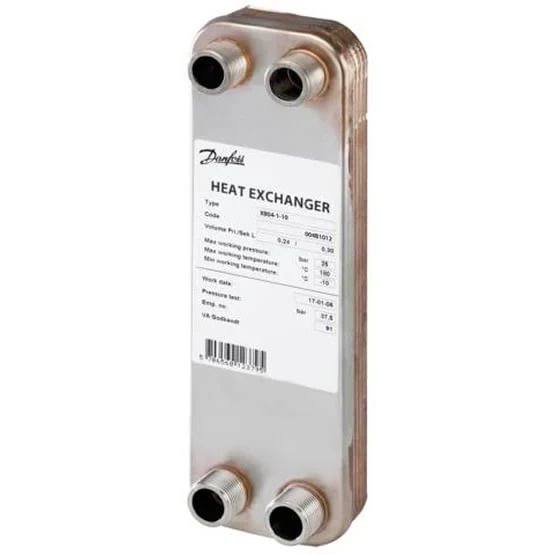
Danfoss XB12M-1 30 CoResist brazed plate heat exchanger, G 1¼", 30 plates, PN 25
- Application: heating loop separation in aggressive DH water
- Plates: 30 pcs, "M" corrugation (medium chevron angle)
- Nominal pressure: PN 25 (25 bar)
- Connection: G 1¼" external thread (DIN ISO 228/1)
Where XB12M-1 30 CoResist is used
This 30-plate exchanger is designed for substation primary/secondary loop separation when district heating water contains elevated chlorides (>50 mg/L) or ammonia. Copper-brazed exchangers wear faster in such conditions; the CoResist nickel filler at critical joints solves this. "M" plate geometry balances heat transfer and pressure drop — a universal choice for heating branches up to ~50 kW capacity. For hard water with elevated Ca/Mg carbonate content, limescale gradually builds up on the plates and reduces heat-transfer efficiency; for such systems gasketed (plate-and-frame) exchangers are preferable, as they can be periodically opened for mechanical or CIP cleaning.
Technical specifications
| Parameter | Value |
|---|---|
| Code | 079G1351 |
| Series | Danfoss XB12 Micro Plate |
| Model | XB12M-1 30 CoResist |
| Number of plates | 30 |
| Plate type | "M" (medium chevron angle) |
| Number of passes | 1-pass (4 connections) |
| Nominal pressure (PN) | 25 bar |
| Temperature range | −10 … +180 °C |
| Connection | G 1¼" external thread (DIN ISO 228/1) |
| Plate material | Stainless steel EN 1.4404 (AISI 316L) |
| Brazing filler | CoResist (Cu+) — nickel-based filler, no copper contact with the fluid |
| Volume per channel | 0.035 L |
| Dimensions (H × W × D) | 289 × 118 × 52 mm |
| Weight | ~3.85 kg |
| Construction | Brazed, hermetic (gasket-free) |
| Media | DH circulation water, glycol solutions up to 50% |
Heat transfer capacity — quick calculation
Capacity depends on flow rate, ΔT and LMTD. General formula: P = Q × ΔT × 1.163 (kW, Q m³/h, ΔT °C).
Example for heating mode (primary 90/70 °C → secondary 65/40 °C): at Q = 1.5 m³/h and effective ΔT ≈ 20 °C → P ≈ 35 kW. With Q = 2.0 m³/h and ΔT ≈ 22 °C → P ≈ 51 kW. Size accurately via Danfoss Hexact.
When to choose XB12M-1 30 CoResist
- Substations with elevated Cl⁻ or ammonia in DH water
- Retrofits where copper-brazed exchangers have leaked earlier
- Small residential heating branches up to ~50 kW
- When extended service life in aggressive DH water is required
- Compatibility: Danfoss XB accessories — mounting bracket (G 1¼" — 004H4200), insulation (PU 004H4210, EPP 004H4201), thread adapters DN20/DN25 (003H6909/003H6910), solder/weld tailpieces
B2B delivery and logistics via Amegata.lt
- 24-hour delivery across Lithuania (from our warehouse in Vilnius)
- Competitive B2B pricing — often below market average
- 30-day payment terms for companies (per contract)
- Free technical consultation on water quality and sizing
Frequently asked questions
When to choose CoResist vs. standard copper brazing?
The recommended threshold is chloride (Cl⁻) concentration in the DH water. Below ~50 mg/L Cl⁻ and without ammonia, copper brazing lasts the full expected life (15-20 years) at lower cost. Above 50 mg/L Cl⁻ or with ammonia, CoResist significantly extends service life. The precise limit depends on pH and temperature — for borderline cases check with Danfoss technical support or contact us. For hard water with elevated Ca/Mg carbonate content, limescale gradually builds up on the plates and reduces heat-transfer efficiency; for such systems gasketed (plate-and-frame) exchangers are preferable, as they can be periodically opened for mechanical or CIP cleaning.
Is the CoResist price proportional to the service life gain?
CoResist typically costs 15-25% more than the standard copper variant. In aggressive water (Cl⁻ >100 mg/L), where copper-brazed units may leak in 3-5 years, CoResist returns the investment within the first operating period. In "clean" water, the price premium won't pay back.
How do I find out my DH network water composition?
Three routes: (1) ask the DH provider — many publish periodic water quality reports; (2) inspect the previous exchanger at the site (weeping or "red" deposits indicate aggressive water); (3) order an independent lab analysis — a certified lab will return Cl⁻, NH₃, pH and hardness results within 3-5 business days.
Is XB12M-1 30 CoResist suitable for domestic hot water (DHW)?
1-pass models are designed only for heating loop separation. For DHW, Danfoss recommends 2-pass models (XB12L-2 or XB12M-2 with additional circulation ports). If you need DHW — contact us and we will recommend the correct 2-pass model.
Is it suitable for potable water systems?
Plates are AISI 316L (stainless steel) and the filler is nickel-based. These materials are recognised as suitable for potable water contact, but WRAS/DVGW certifications for the specific CoResist variant vary by country — if you design a potable water system in Lithuania or the EU, contact us to verify current compliance documents before shipment.


