
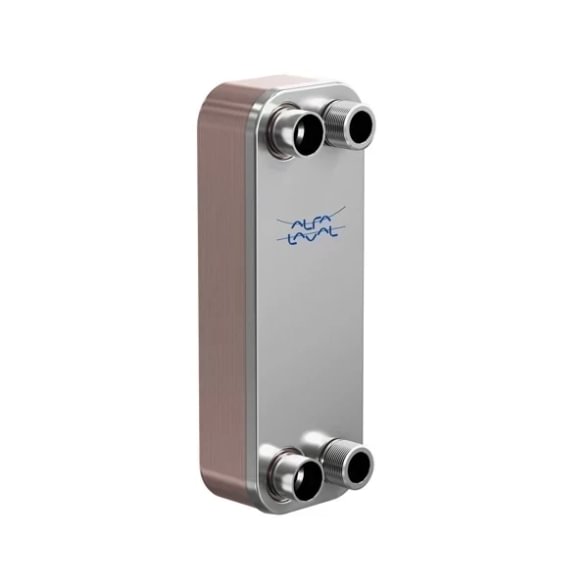
CB30-100H brazed plate heat exchanger, 100 plates
Where the CB30-100H is used
The Alfa Laval CB30-100H is built for medium-capacity heating and cooling circuits. Typical duties:
- domestic hot water preparation in a substation;
- separating an underfloor heating loop from the boiler;
- heat pump and ground loop separation;
- process water and oil cooling.
The compact pack fits where a gasketed (dismountable) heat exchanger no longer has room. Every unit is pressure and leak tested at the factory. The construction is a stack of corrugated stainless steel plates vacuum-brazed with copper: the filler bonds the plates at their contact points, so the pack holds high pressure without gaskets or tie bolts. The letter H denotes a plate pattern with higher heat transfer intensity — the L and M patterns give lower pressure drop, but also less heat from the same area.
Technical specifications
| Manufacturer | Alfa Laval |
| Model | CB30-100H |
| Manufacturer code | 3287089492 |
| Type | Brazed plate heat exchanger |
| Number of plates | 100 |
| Plate material | Stainless steel (AISI 316) |
| Brazing filler | Copper (Cu) |
| Cover plate and connection material | Stainless steel |
| Connections | CB30 range standard — 1" (DN25) external thread; 1¼", soldered and welded options available. We confirm the exact variant of this code against the Alfa Laval drawing |
| Design pressure PS (PED) | 40 bar (S3–S4) / 39 bar (S1–S2) up to +90 °C; ~32 bar at +225 °C |
| Design pressure (UL) | 31 bar |
| Working temperature (PED) | −196…+225 °C |
| Vacuum | Designed for full vacuum |
| Volume per channel | 0.054 l |
| Max. flow rate | 14 m³/h (water, 5 m/s connection velocity) |
| Max. particle size | 1 mm |
| Channel arrangement | Parallel (single pass); streams piped counter-current |
| Plate dimensions | 313 × 113 mm |
| Port centre distances | 250 × 50 mm |
| Pack depth | ~244 mm (13 + 2.31 × number of plates) |
| Weight | ~12.2 kg (excluding connections) |
How to size it
Required flow rate: Q = P / (1.163 × ΔT), where Q is m³/h, P is duty in kW and ΔT the temperature difference in °C; 1.163 is an approximate constant for water that shifts slightly with temperature. 200 kW at ΔT = 20 °C gives ≈ 8.6 m³/h. The constant applies to water; with glycol mixtures the flow rises by 10–20 %. The 14 m³/h in the table is the theoretical limit at 5 m/s connection velocity; in practice systems are designed at 2–3 m/s, roughly 6–8 m³/h.
The plate count sets the heat transfer area, and with it the temperature approach and pressure drop. 100 plates sits in the upper part of the CB30 range (150 max). Send us an enquiry with the duty, flow rates and temperatures — we will size the unit, confirm the connections and quote it.
When to choose a 100-plate heat exchanger
- When space is tight but duty is high — a brazed pack takes several times less room than a gasketed (dismountable) unit.
- When the loop carries clean, treated water free of particles larger than 1 mm.
- When circuits must be hydraulically separated: underfloor heating from the boiler, a ground loop from the building system.
- When a tight temperature approach (2–5 °C) and efficient heat recovery are required.
Frequently asked questions
Can this heat exchanger be opened and cleaned?
No — the plates are brazed into a single pack and it cannot be opened mechanically. Cleaning is chemical only, circulating a cleaning solution (CIP) through the connections.
Is it suitable for aggressive or hard water?
Not always. Copper brazing is sensitive to chlorides and ammonia — for such media a stainless steel brazed version is selected instead. Hard, limescale-forming water (Ca and Mg carbonate hardness) deposits on the plates and cuts capacity. CIP removes fresh deposits, but a thick hardened layer often resists chemical cleaning, and a brazed pack cannot be opened for mechanical cleaning. For hard water without treatment, gasketed (dismountable) heat exchangers are therefore the better choice.
Which direction should the streams be piped?
Counter-current — the heated and heating media must flow in opposite directions. Only then is a tight temperature approach achieved; a co-current connection reduces capacity.
Is a strainer needed upstream?
Yes. The allowable particle size is up to 1 mm, so a dirt strainer (typically 0.5 mm mesh) is fitted ahead of the unit, especially in old pipework.


