
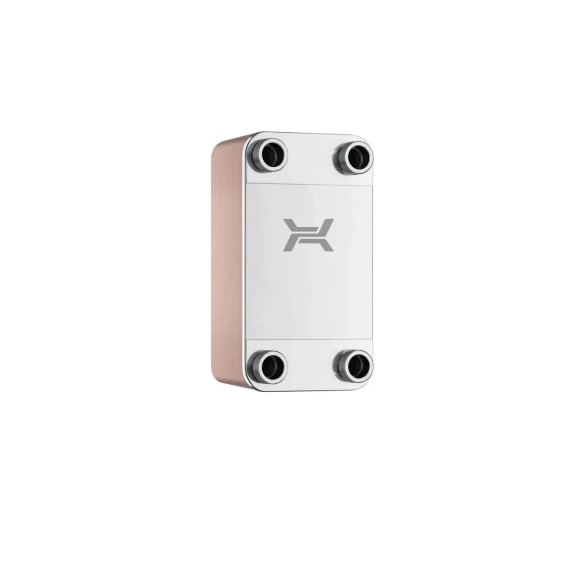
Hexonic LB31-80H-2S-5/4 brazed plate heat exchanger, 80 plates, PN 30
- Application: heating/cooling/DHW primary–secondary loop separation
- Heat capacity: ~50-100 kW (depending on flow rate and ΔT)
- Nominal pressure: PN 30 (3.0 MPa)
- Connection: G 1¼" (5/4) external thread (both sides)
Where LB31-80H is used
This 80-plate brazed heat exchanger with H (high) chevron angle and 2-pass (2S) configuration is typically chosen for domestic hot water (DHW) primary circuits in multi-family substations (primary side — district heating network, secondary side — DHW). The 2-pass configuration with 6 connections efficiently maintains the logarithmic mean temperature difference (LMTD) under asymmetric DHW loads (e.g., 70/40 °C → 10/55 °C). The compact housing (68 × 286 mm base × height) fits even in tight technical rooms.
Technical specifications
| Parameter | Value |
|---|---|
| Code | 0203-0719 |
| Series | Hexonic LB31 |
| Model | LB31-80H-2S-5/4 |
| Number of plates | 80 |
| Configuration | 2-pass (2S), 6 connections |
| Nominal pressure (PN) | 30 bar (3.0 MPa) |
| Connection | G 1¼" (5/4) external thread |
| Plate material | Stainless steel AISI 316L |
| Brazing material | Copper |
| Working temperature range | −196 °C … +200 °C |
| Dimensions (W × D × H) | 68 × 198.0 × 286 mm (W × D × H) |
| Weight (approx.) | ~10.72 kg |
| Construction | Vacuum-furnace brazed, hermetic (gasket-free) |
| Media | Water, glycol solutions (ethylene, propylene), other media compatible with stainless steel and copper |
Heat transfer capacity — quick calculation
Capacity depends on flow rate, ΔT and logarithmic mean temperature difference (LMTD). General formula: P = Q × ΔT × 1.163 (kW, where Q — m³/h, ΔT — °C).
Example for typical heating duty (primary 90/70 °C → secondary 65/40 °C): at Q = 2.6 m³/h and effective ΔT ≈ 25 °C → P ≈ 75 kW. This model's practical range is ~50-100 kW (final sizing determined by design conditions and Hexonic CAIRO selection software).
When to choose LB31-80H
- Heating/cooling primary–secondary loop separation in the ~50-100 kW range
- Domestic hot water (DHW) primary heat exchanger with 2-pass LMTD optimization
- Cooling systems buffer separation (chilled water primary / building loop secondary)
- When gasket-free hermetic construction is required
- Water and glycol (up to 50 %) systems with appropriate inhibitors
B2B delivery and logistics via Amegata.lt
- 24-hour delivery across Lithuania (from our warehouse in Vilnius)
- Competitive B2B pricing — often below market average
- 30-day payment terms for companies (per contract)
- Free technical consultation for sizing and CAIRO calculation
Frequently asked questions
What is the difference between "H", "M" and "L" plate profiles?
The letter denotes the plate chevron angle: "H" — high angle (higher heat transfer coefficient, higher pressure drop), "M" — medium, "L" — low (lower Δp, suits higher flow rates). Hexonic LB31 has an H variant, while LC110 and LM110 encode the profile angle in the series name ("C" — larger channel volume, "M" — medium).
Is it suitable for ethylene glycol and propylene glycol solutions?
Yes. Hexonic L-series copper-brazed exchangers are compatible with ethylene glycol and propylene glycol solutions up to 50 %, when appropriate inhibitors are used. For DHW systems, only potable-grade fluids are allowed.
What maintenance is required?
Brazed gasket-free construction requires no periodic disassembly maintenance. Recommended only CIP (Clean-in-Place) flushing every 3-5 years if fouling signs appear (rising pressure drop or falling heat transfer). Suitable CIP reagents — mild acid solutions (e.g., citric, sulfamic acid) followed by neutralization and rinsing.
Is it suitable for potable water (DHW)?
Yes. AISI 316L stainless steel plates and copper brazing meet potable water system requirements (DVGW, WRAS and similar certifications, depending on country). In DHW systems, the 2-pass (2S) configuration is typical due to the asymmetric LMTD duty.
Is it suitable for aggressive water with chlorides or ammonia?
In some regions, district-heating water contains elevated chlorides or ammonia — in such systems, copper brazing may shorten the service life of the exchanger. In these cases we recommend the Danfoss XB CoResist series — stainless-steel brazing, copper-free. For hard water with elevated Ca/Mg carbonate content, limescale gradually builds up on the plates and reduces heat-transfer efficiency; for such systems gasketed (plate-and-frame) exchangers are preferable, as they can be periodically opened for mechanical or CIP cleaning. Contact us — we will select the model best suited to your water conditions.

