
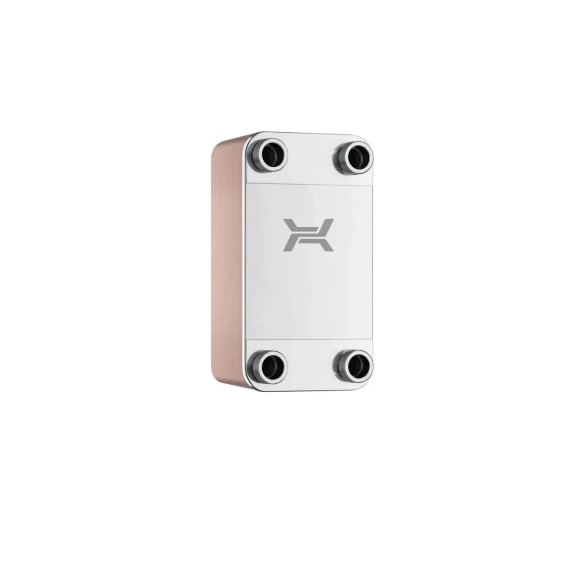
Hexonic LM110-30-2 brazed plate heat exchanger, 2", 30 plates, PN 25
- Application: high-efficiency HVAC, heat pumps, chillers, industrial processes
- Heat capacity: ~150-360 kW (higher than LC110 for the same size class)
- Nominal pressure: PN 25 (25 bar)
- Connection: G 2" external threads
Where LM110-30-2 is used
LM110 — Micro-channel version of the Hexonic L-series with an improved plate geometry. Compared to traditional chevron plates, micro-channel plates increase heat transfer efficiency by up to 35 % (per Hexonic published data). Used where maximum efficiency in minimum footprint matters: heat pumps, chillers, high-precision temperature control in industrial processes.
Technical specifications
| Parameter | Value |
|---|---|
| Code | 0209-0003 |
| Series | Hexonic LM110 (Micro-channel) |
| Model | LM110-30-2 |
| Number of plates | 30 |
| Passes | 1 (1-pass, 4 connections) |
| Nominal pressure (PN) | 25 bar |
| Max working temperature | 230 °C |
| Min working temperature | -195 °C |
| Connection | G 2" external thread |
| Plate material | Stainless steel AISI 316L (1.4404) |
| Brazing filler | Copper (Cu) |
| Plate dimensions | 619 × 190 mm |
| Unit depth (F) | ~88.0 mm (formula: 10 + 2.6 × N, N = 30) |
| Weight | ~20.6 kg |
| Construction | Brazed, hermetic, micro-channel plate |
| Media | Water, glycol solutions up to 50 % |
Heat transfer capacity — quick calculation
General formula: P = Q × ΔT × 1.163. Micro-channel plates deliver the same P with fewer plates — vs. traditional LC110, LM110 offers ~15-20 % more capacity per plate count.
Example for heating mode (primary 90/70 °C → secondary 65/40 °C): at Q ≈ 11.0 m³/h and effective ΔT ≈ 20 °C → P ≈ 255 kW.
When to choose LM110-30-2
- When maximum efficiency in a small footprint is needed (heat pumps, high-class HVAC)
- When capacity demand is ~150-360 kW and plate count reduction matters
- When the system has adequate filtration (<500 μm)
- When energy efficiency credits (BREEAM, LEED) are targeted
When to choose an alternative
- Dirty water systems → LC110 (wider plate gaps)
- When price outweighs the ~15 % efficiency edge → LC110
- Pressure >25 bar → gasketed exchanger
B2B delivery and logistics via Amegata.lt
- 24-hour delivery across Lithuania (from our warehouse in Vilnius)
- LM110 models — often made-to-order, we will confirm lead time
- 30-day payment terms for companies (per contract)
- Free technical consultation for sizing selection
Official Hexonic catalogue: hexonic.com/brazed-plate-exchangers/L
Frequently asked questions
How does LM110 differ from LC110?
LM110 — micro-channel plate: higher heat transfer with lower flow resistance (per Hexonic — up to 8 % more efficiency and 9 % less Δp). LC110 — traditional chevron plate. LM110 is preferred for heat pumps and chillers; LC110 is more universal for substations.
Can glycol mixtures be used?
Yes, up to 50 % with inhibitors.
What maintenance is required?
CIP flushing every 2-3 years (micro-channel needs it more often than traditional plates, as smaller gaps are more sensitive to fouling). A filter upstream is mandatory.
Is it suitable for potable water?
Yes. AISI 316L + copper meets WRAS/DVGW.
Does it need a special pump?
No — micro-channel plates have lower Δp than traditional plates at the same flow, so a standard heating-system circulation pump is sufficient.

