
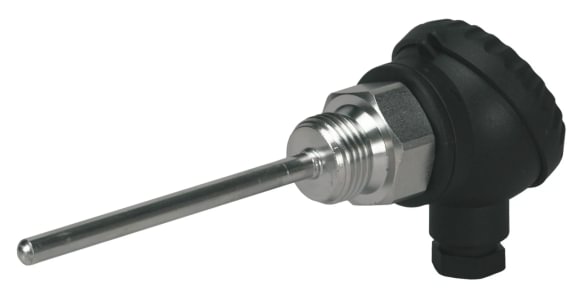
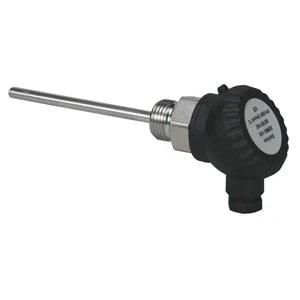
Danfoss ESMU-100 immersion temperature sensor, Pt1000, 100 mm, 0…+140 °C
- Type: Pt1000 (class B per EN 60751)
- Measuring range: 0…+140 °C
- Probe length / fitting: 100 mm / G½"
- Pressure / IP: 25 bar / IP54
Where ESMU-100 is used
ESMU-100 is the reference temperature sensor for substations — you will find it in virtually every district-heating substation running Danfoss ECL Comfort 210/310, measuring primary and secondary supply/return, DHW temperature after the heat exchanger, and heating loop supply temperature ahead of the circulator. The G½" thread lets it screw directly into a pipe tee or into a separately ordered pocket.
Technical specifications
| Parameter | Value |
|---|---|
| Code | 087B1182 |
| Model | ESMU-100 |
| Type | Pt1000 (class B per EN 60751) |
| Application | Immersion in pipework — water / glycol temperature |
| Measuring range | 0…+140 °C |
| Accuracy (class B) | ±(0.3 + 0.005 × \|t\|) °C |
| Output signal | 1000 Ω at 0 °C (Pt1000 characteristic) |
| Time constant (τ) | 2 s in water / 7 s in air |
| Nominal pressure | 25 bar |
| Probe length | 100 mm |
| Probe diameter | 6 mm |
| Probe material | Stainless steel AISI 316 |
| Thread | G½" (washer included) |
| Connection | Terminal block for 2-wire cable, PG9 cable gland |
| Ingress protection | IP54 |
| Weight | ~132 g |
When to choose ESMU-100
- New or renovated substation with an ECL Comfort controller
- High-accuracy temperature required for primary / secondary loop, DHW and heating circuits
- System with pressure surges or high temperatures — a robust sensor is needed (AISI 316, 25 bar, 140 °C)
- Compatibility: Danfoss ECL Comfort 110 / 210 / 296 / 310 (all application keys); any other controller accepting Pt1000 signal
When to choose a longer probe
- Larger pipes (DN 100+) — the Danfoss range includes ESMU-250 (250 mm probe)
- Storage tanks (calorifiers) with stratification monitoring
B2B delivery and logistics via Amegata.lt
- 24-hour delivery across Lithuania (from our warehouse in Vilnius)
- Competitive B2B pricing — often below market average
- 30-day payment terms for companies (per contract)
- Free technical consultation on sensor / pocket assembly
Official Danfoss catalogue: store.danfoss.com/087B1182
Frequently asked questions
Can it be mounted without a pocket?
Yes — ESMU-100 has a standard G½" thread and can be screwed directly into a pipe tee with a matching internal thread. For hot water or district heating up to 25 bar this is standard practice. We recommend a pocket in systems where the sensor will be changed often or periodically recalibrated.
How is it different from ESMU-250?
Probe length: ESMU-100 = 100 mm (for DN 15-50 pipes), ESMU-250 = 250 mm (for larger pipes DN 65+ and tanks). All other parameters are identical.
Is it suitable for glycol solutions?
Yes. AISI 316 stainless steel resists ethylene glycol and propylene glycol solutions up to 50 % concentration. With proper inhibitors, no long-term issues.
What is the maximum cable length?
Recommended up to 50 m with 2 × 1.5 mm² cable. For longer runs (up to 100 m) use 2 × 2.5 mm² or a 3-wire connection with controller-side compensation. In EMC-noisy environments, use shielded cable grounded on the controller side only.
Does it need calibration?
The factory-set Pt1000 element does not require calibration in normal operation. For critical applications (heat meters, commercial billing), an accredited metrology lab can calibrate it once every 3-5 years.


