
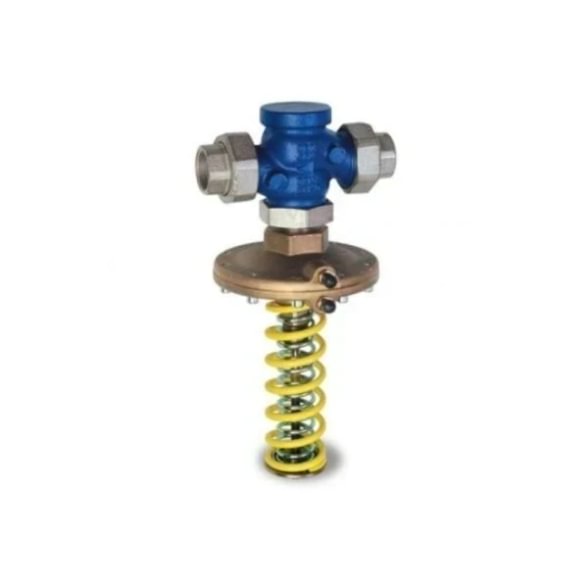
IMI TA Hydronics DA-616 15/5 differential pressure controller
- Application: constant Δp on a small heating branch — stable control for thermostatic and zone valves
- DN: 15 — smallest DA-616 variant
- Kvs: 5 m³/h — suits ~15-40 kW heating load
- Setting range: per variant (check IMI catalogue)
Where DA-616 DN15 Kvs 5 is used
Applied for hydraulic balancing of small consumer branches — floor-level heating risers in 2-3 storey multi-family buildings, apartment metering schemes with thermostatic heads, small cooling zones in commercial buildings. DA-616 automatically holds a constant Δp across the controlled branch — so thermostatic valves see a stable pressure drop and operate at a consistent characteristic point, regardless of other consumer activity in the system.
Technical specifications
| Parameter | Value |
|---|---|
| Code | 52-861-015 |
| Series | IMI TA Hydronics DA-616 |
| Type | Automatic differential pressure (Δp) controller |
| DN | 15 |
| Kvs | 5 m³/h |
| Nominal pressure (PN) | 16 bar (verify in IMI catalogue) |
| Δp setting range | Per variant (typically 5-30 kPa or 10-60 kPa — see IMI documentation) |
| Connection | Internal thread (Rp) |
| Temperature range | -10 → +120 °C |
| Media | Heating/cooling water, glycol up to 50 % |
| Body material | DZR brass / bronze (per IMI documentation) |
| Capillary tube | Ordered separately (code 52-850-915 or equivalent) |
Capacity — quick calculation
Water flow through the valve: Q = Kvs × √Δp (Δp in bar; Q in m³/h). Heat capacity: P = Q × ΔT × 1.163 (kW, ΔT °C, Q m³/h).
Example: setting Δp = 0.3 bar (30 kPa) → Q = 5 × √0.3 ≈ 2.74 m³/h. With ΔT = 15 °C → P ≈ 48 kW.
When to choose DA-616 DN15 Kvs 5
- Small heating branches up to ~40-50 kW hydraulic balancing
- Single-floor or small (2-3 storey) multi-family heating risers
- Apartment metering schemes with thermostatic valves
- When self-powered control without electrics is required
B2B delivery and logistics via Amegata.lt
- 24-hour delivery across the EU (from our warehouse in Vilnius)
- Competitive B2B pricing — often below market average
- 30-day payment terms for companies (per contract)
- Free technical consultation for valve sizing
Official IMI Hydronic catalogue: imi-hydronic.com
Frequently asked questions
How does DA-616 differ from Danfoss AVP?
Functionally equivalent: both are proportional automatic Δp controllers on the consumer branch. Differences: IMI TA Hydronics uses different capillary connections, diaphragm construction and Δp range classes. In practice, one can substitute the other at the same Kvs.
Is a capillary tube required?
Yes. DA-616 operates hydraulically — a capillary tube is essential (IMI TA Hydronics 52-850-915 or equivalent) to transmit the pressure signal from the consumer branch. The capillary is not included in the package.
Can it be used with antifreeze?
Yes. IMI Hydronics allows use with ethylene or propylene glycol solutions up to 50 %, with proper inhibitors.
How is the Δp setpoint chosen?
The Δp setpoint must match the design pressure drop of the thermostatic valves plus the branch pressure losses. For a domestic branch with thermostatic heads, typical settings are 10-20 kPa (0.1-0.2 bar). Higher settings risk noise and cavitation in the valves.
