
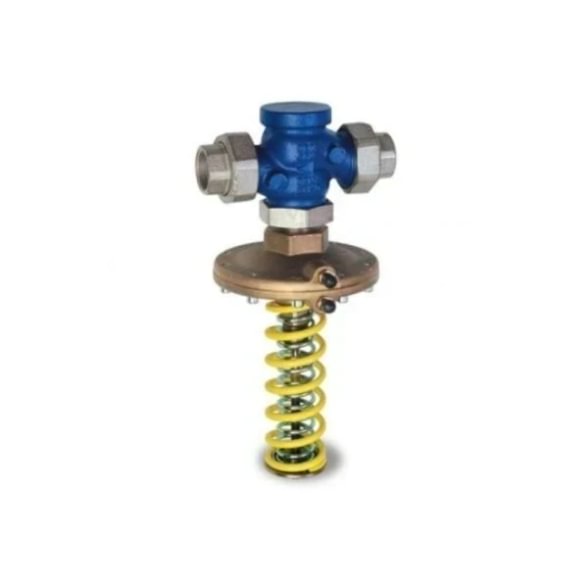
IMI TA Hydronics DA-616 32/15 differential pressure controller
- Application: constant Δp on a high-load heating header
- DN: 32 — largest DA-616 size
- Kvs: 15 m³/h — suits ~150-250 kW heating load
- Autonomy: hydraulic operation, no electrics
Where DA-616 DN32 Kvs 15 is used
For high-load heating headers — commercial buildings (offices, shopping centres), high-rise residential heating branches, schools and hotels with combined building heat load up to ~250 kW. Provides stable Δp across a large consumer network when load is distributed among many users with varying operating patterns.
Technical specifications
| Parameter | Value |
|---|---|
| Code | 52-861-032 |
| Series | IMI TA Hydronics DA-616 |
| Type | Automatic differential pressure (Δp) controller |
| DN | 32 |
| Kvs | 15 m³/h |
| Nominal pressure (PN) | 16 bar (verify in IMI catalogue) |
| Δp setting range | Per variant — see IMI documentation |
| Connection | Internal thread (Rp) |
| Temperature range | -10 → +120 °C |
| Media | Heating/cooling water, glycol up to 50 % |
| Body material | DZR brass / bronze (per IMI documentation) |
| Capillary tube | Ordered separately (52-850-915 or equivalent) |
Capacity — quick calculation
Water flow: Q = Kvs × √Δp. Heat capacity: P = Q × ΔT × 1.163.
Example: setting Δp = 0.3 bar (30 kPa) → Q = 15 × √0.3 ≈ 8.22 m³/h. With ΔT = 20 °C → P ≈ 191 kW.
When to choose DA-616 DN32 Kvs 15
- Commercial buildings with 150-250 kW combined heating load
- High-rise multi-family heating headers
- Medium industrial process heating branches
- Shopping centres, schools, hotels with central heating branches
B2B delivery and logistics via Amegata.lt
- 24-hour delivery across the EU (from our warehouse in Vilnius)
- Competitive B2B pricing — often below market average
- 30-day payment terms for companies (per contract)
- Free technical consultation for valve sizing
Official IMI Hydronic catalogue: imi-hydronic.com
Frequently asked questions
When to choose DN32 over DN25?
When calculated flow at the target Δp exceeds DN25 Kvs 10 capacity. Example: if desired flow is 6 m³/h at Δp = 20 kPa, DN25 provides only 10 × √0.2 ≈ 4.47 m³/h (insufficient). DN32 with Kvs 15 provides 15 × √0.2 ≈ 6.7 m³/h — meets the requirement. Otherwise DN32 is oversized.
Can DA-616 DN32 be used on the primary DH consumer side?
Only on the secondary side after the heat exchanger (building side). The primary DH supply side (before the exchanger) requires different Δp regulators with higher working pressure and temperature — e.g. PICV combined with temperature limiting.
Can multiple DA-616 units be piped in parallel?
Theoretically possible, practically uneconomical. Better solution — a larger Kvs valve or a dedicated high-load DN solution. Parallel units may require additional synchronisation and more complex hydraulic layout.
Is special insulation required for DN32?
In cooling systems (media below room temperature) condensate-prevention insulation is essential. In heating systems insulation is recommended per energy regulations — typically 25-40 mm mineral wool with vapour barrier.
