
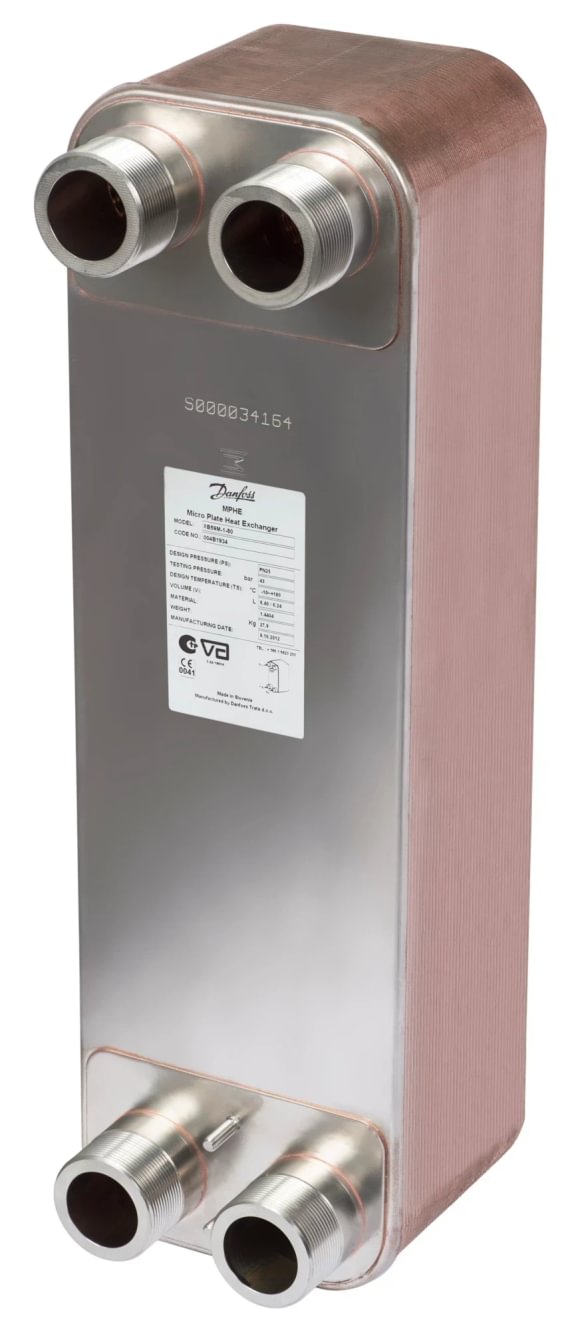
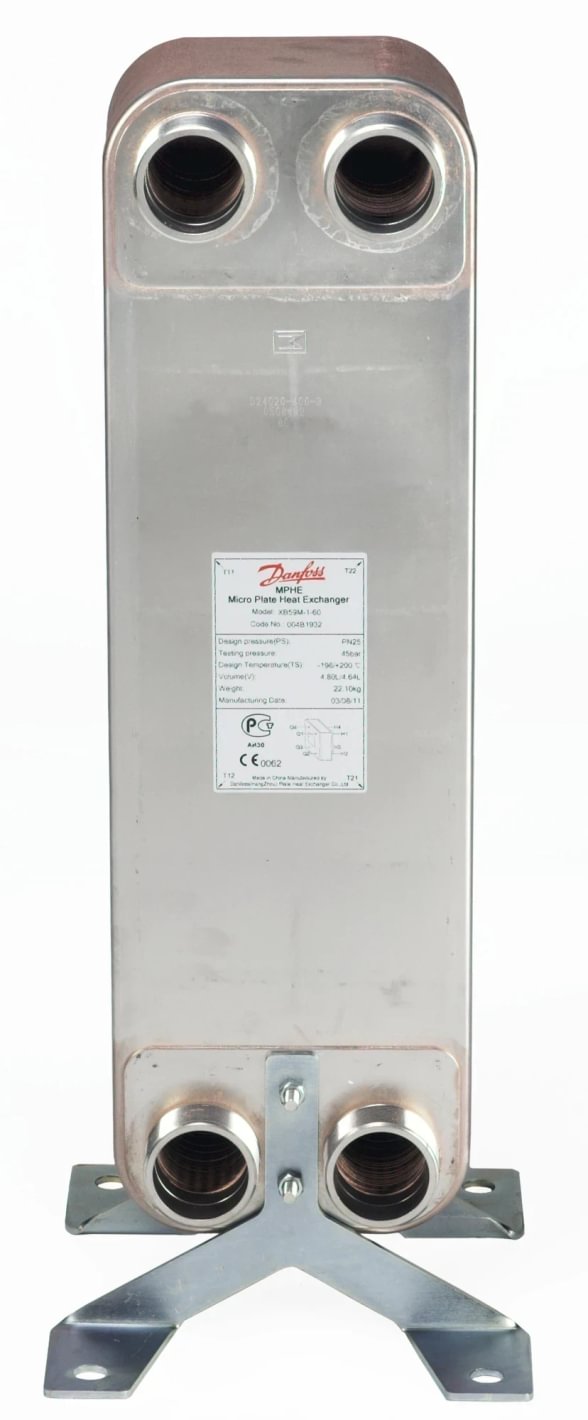
Danfoss XB59M-1 50 1-pass brazed plate heat exchanger, G 2", 50 plates, PN 25
- Application: primary (district heating) / secondary (building) loop separation — space heating, single-stage DHW
- Heat capacity: ~140-320 kW (depending on flow and ΔT)
- Nominal pressure: PN 25 (25 bar) — both circuits
- Connection: G 2" external thread (ISO 228/1)
Where XB59M-1 50 is used
XB59M-1 is a larger single-pass member of Danfoss Micro Plate™ range for district heating substations where higher heating capacity is needed than typical XB37 or XB52 units. Primary side — district heating network (often 90/70 °C or 110/70 °C schedule), secondary — building heating (radiators 65/40 °C, floor heating 45/30 °C, HVAC preheat).
Typical applications: large apartment buildings, office complexes, shopping centres, schools, hospitals, hotels with heating demand ~140-320 kW. Also suitable for single-stage DHW where district heating return temperature reduction is not mandatory.
Technical specifications
| Parameter | Value |
|---|---|
| Code | 004B1923 |
| Series | Danfoss XB59M-1 (Micro Plate™, 1-pass) |
| Model | XB59M-1 50 |
| Number of plates | 50 |
| Nominal pressure (PN) | 25 bar (both circuits) |
| Connection | G 2" external thread (ISO 228/1) |
| Plate material | Stainless steel 1.4404 (AISI 316L) |
| Brazing filler | Copper |
| Temperature range | -196 … +180 °C |
| Height (without feet) | ~540 mm |
| Width | 186 mm |
| Weight | ~19.0 kg |
| Construction | Brazed, hermetic (gasket-free); single-pass design |
| Certification | PED 2014/68/EU, category II |
| Media | Water, glycol solutions; potable water on secondary side (if DHW) |
Heat transfer capacity — quick calculation
General formula: P = Q × ΔT × 1.163 (kW, Q m³/h, ΔT °C).
Heating example (primary 90/70 °C → secondary 65/40 °C, effective ΔT ≈ 25 °C): at Q = 7.9 m³/h → P ≈ 230 kW. Actual capacity headroom depends on LMTD and duty regime.
When to choose XB59M-1 50
- District heating substation with heating demand ~140-320 kW
- Single-stage heating for radiators (65/40 °C), floor heating (45/30 °C) or HVAC coils
- Larger buildings — apartment blocks, offices, shopping centres, schools, hotels
- When a reliable maintenance-free solution is required (brazed gasket-free construction)
- Compatibility: typical package — Danfoss ECL Comfort 210 / 310 controller + AME actuator + VF/VFG regulating valve + ESM/ESMU sensors
B2B delivery and logistics via Amegata.lt
- 24-hour delivery across Lithuania (from our warehouse in Vilnius)
- Competitive B2B pricing — often below market average
- 30-day payment terms for companies (per contract)
- Free technical consultation for sizing selection (HEXact calculation)
Frequently asked questions
How does 1-pass differ from 2-pass in DHW applications?
1-pass — primary flow passes the plate pack once. 2-pass — primary flow is split into two sections (stage I heated by return flow energy, stage II by supply flow). 2-pass significantly lowers district heating return temperature (important where utilities apply penalties). 1-pass is simpler, with lower primary-side losses, but less efficient in terms of return-flow utilisation.
Can glycol mixtures be used?
Yes. XB59 series is compatible with ethylene and propylene glycol solutions up to 50 %, with appropriate inhibitors. Potable secondary side — only potable-grade fluids.
What maintenance is required?
Brazed gasket-free construction requires no periodic disassembly. Only CIP (Clean-in-Place) flushing every 3–5 years recommended if fouling signs appear (rising Δp, falling heat transfer).
Is it suitable for regions with aggressive water?
Chlorides or ammonia in district heating water can shorten the service life of a copper-brazed exchanger. In such cases In these cases we recommend the Danfoss XB CoResist series — stainless-steel brazing, copper-free. For hard water with elevated Ca/Mg carbonate content, limescale gradually builds up on the plates and reduces heat-transfer efficiency; for such systems gasketed (plate-and-frame) exchangers are preferable, as they can be periodically opened for mechanical or CIP cleaning. Contact us for a match to your water conditions.
Is it suitable for potable water?
Yes. Stainless steel 1.4404 plates and copper brazing meet potable water system requirements (EN, DVGW, WRAS, depending on country).


