
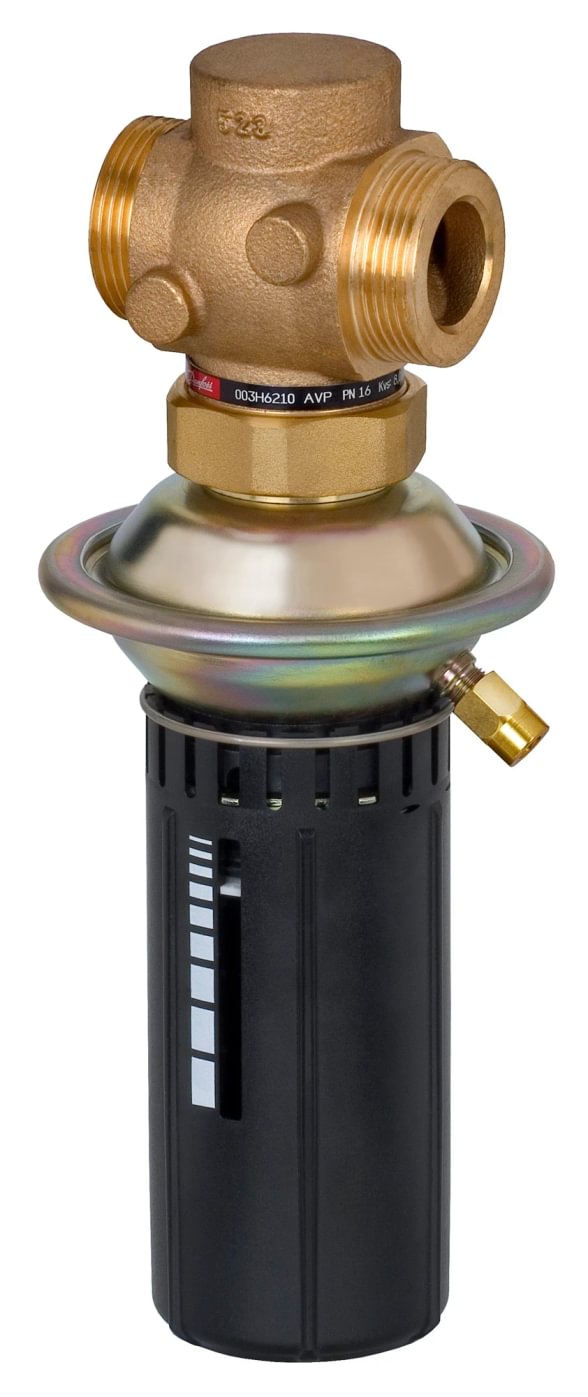
Danfoss AVP PN 16 DN 25 Kvs 8 Δp 0,2-1 bar
- Function: maintain constant Δp on the consumer branch — hydraulic balancing without electricity
- Kvs: 8 m³/h — fits ~120-180 kW loops (Δp 0.5 bar / ΔT 20 °C)
- Setting range: 0.2-1 bar
- Connection: G 1 1/4" A male thread
Applications
Larger heating risers in multi-unit residential buildings (5-9 storeys), larger commercial substations consumer branches, more complex apartment-metering schematics with higher total flow. The valve stabilises Δp across the regulated section — thermostatic heads and heat-metering readings become consistent regardless of other consumers. Delivery across the EU.
Technical specifications
| Parameter | Value |
|---|---|
| Code | 003H6248 |
| Type | AVP — differential-pressure controller |
| DN | 25 |
| Kvs | 8 m³/h |
| Nominal pressure (PN) | 16 bar |
| Δp setting range | 0.2-1 bar |
| Max Δp across valve | 12 bar |
| Connection | G 1 1/4" A male thread |
| Temperature range | 2 → 150 °C |
| Media | DH water; glycol up to 30 %; pH 7-10 |
| Valve position | Normally open |
| Leakage class | 0.02 % Kvs |
| Body material | Red bronze CuSn5ZnPb (Rg5) |
| Diaphragm | EPDM |
Flow/power sizing
Q = Kvs × √Δp; P = Q × ΔT × 1.163. Example: Δp 0.5 bar → Q ≈ 5.66 m³/h; ΔT 20 °C → P ≈ 132 kW.
Notes for the designer
Valve authority β ≥ 0.5. AVP is sized by Kvs, not by DN. DN 25 with Kvs 8 fits situations where DN 20 Kvs 6.3 would be undersized and DN 32 Kvs 12.5 would give insufficient authority.
DN 25 (Kvs 8) vs DN 20 (Kvs 6.3) — when to choose
- Heat load 100-180 kW at design Δp
- Higher flow — DN 20 would give excessive Δp across the valve
- Metering schematics in taller / larger multi-unit buildings
- Pipework already DN 25 — fewer reducers needed
B2B delivery and logistics
- Delivery across the EU (from warehouse in Vilnius, LT)
- Competitive B2B pricing
- 30-day payment terms for companies
- Free consultation on valve sizing
Official Danfoss catalog: store.danfoss.com/003H6248
FAQ
AVP vs AVPQ?
AVP — differential-pressure controller. AVPQ — combined flow + Δp controller (two functions in one body).
Is an impulse tube required?
Yes. AVP is hydraulically driven — it needs a capillary tube (e.g. 003H6929, copper 6 mm × 1500 mm, R 1/2). The tube is not included in the AVP carton.
Suitable for chilled water?
Yes. Danfoss approves AVP for chilled-water systems with glycol up to 30 %.
PN 16 vs PN 25 — when to choose?
Most Lithuanian residential heating systems operate up to 10 bar — PN 16 has sufficient margin. PN 25 is chosen for higher-load commercial or high-rise substations.


