
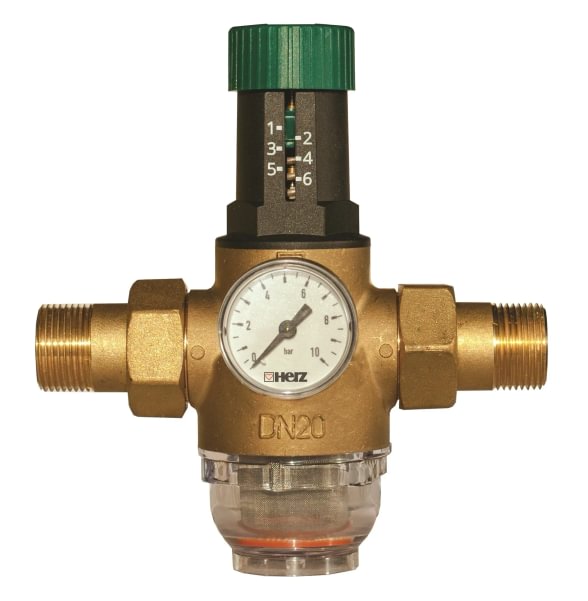
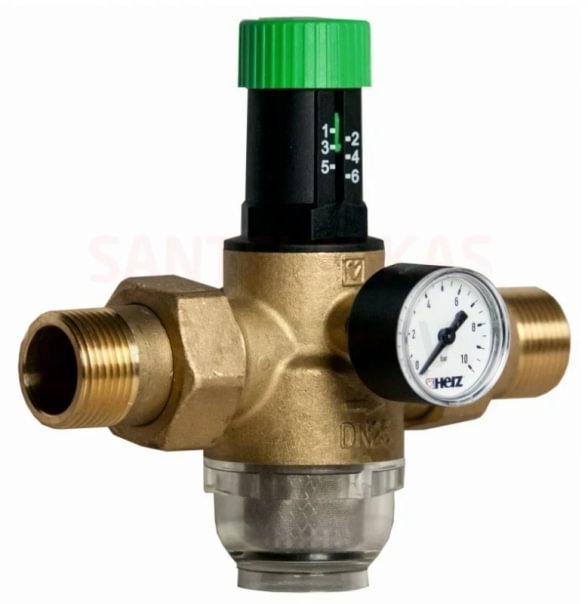
Herz DN20 pressure reducer
- Purpose: stable outlet pressure independent of inlet fluctuations
- DN: 20 — commonly used domestic and small commercial size
- Kvs: ~5 m³/h (verify in Herz catalogue)
- Compatibility: potable water, heating system water
Where Herz DN20 pressure reducer is used
Standard component at the water supply entry to a building or in the heating system make-up line, where high mains pressure (often 6-10 bar in city networks) must be reduced to a safe and comfortable working value (2-4 bar). Prevents damage to fixtures, fittings and internal pipework from over-pressure, reduces water hammer and lowers water consumption.
Technical specifications
| Parameter | Value |
|---|---|
| Code | 1268212 |
| Manufacturer | Herz Armaturen |
| Type | Diaphragm pressure reducing valve |
| DN | 20 |
| Connection | 3/4" internal thread (verify in Herz catalogue) |
| Kvs | ~5 m³/h (verify in Herz catalogue) |
| Inlet pressure (max) | up to 25 bar (verify in Herz catalogue) |
| Outlet pressure (adjustable) | 1.5-6 bar (typical Herz range) |
| Max working temperature | up to 80 °C (potable water) |
| Media | Potable water, heating system water |
| Body material | Brass (typically DZR) |
| Diaphragm | Elastomer (EPDM or equivalent) |
Capacity — quick calculation
Water flow: Q = Kvs × √Δp (Δp = inlet − outlet pressure, bar). Example: inlet 6 bar, outlet 3 bar → Δp = 3 bar → Q = 5 × √3 ≈ 8.66 m³/h theoretical maximum flow.
When to choose Herz DN20
- Single-family house / small multi-family building with 3/4" potable inlet
- Heating system make-up line (together with a BA system separator per EN 1717)
- Domestic systems where mains pressure exceeds 5 bar
- Protection against network pressure spikes (water hammer prevention)
B2B delivery and logistics via Amegata.lt
- 24-hour delivery across the EU (from our warehouse in Vilnius)
- Competitive B2B pricing — often below market average
- 30-day payment terms for companies (per contract)
- Free technical consultation on reducer sizing
Official Herz catalogue: herz.eu
Frequently asked questions
Is a strainer required upstream?
Yes, essential. Mains water debris (rust, sand, scale) settles directly on the diaphragm and seat — the reducer will leak or lose regulation. Standard: Y-strainer 500 μm or finer, upstream.
How is the outlet pressure set?
Via the adjustment screw (exact procedure in Herz documentation). Before adjustment, close the outlet side, wind the adjustment mechanism to zero, then gradually raise to the target value while monitoring the gauge. Setup is usually a one-off task at system commissioning.
Can it be used with hot water?
Standard Herz DN20 (1268212) is rated up to 80 °C. Hot water applications (DHW above 80 °C) require dedicated hot-water models with temperature-resistant materials.
Is a separate gauge required?
Recommended. A gauge upstream shows mains pressure, downstream shows the set outlet pressure. Without it, it is impossible to verify that the reducer still regulates correctly (essential for detecting gradual drift over years).


