
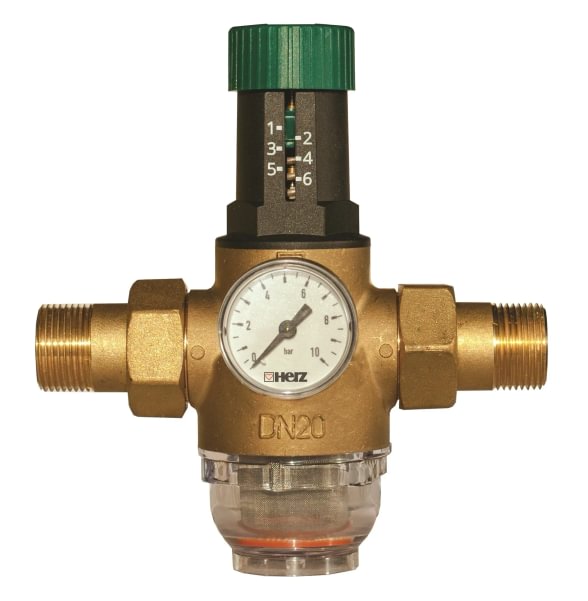
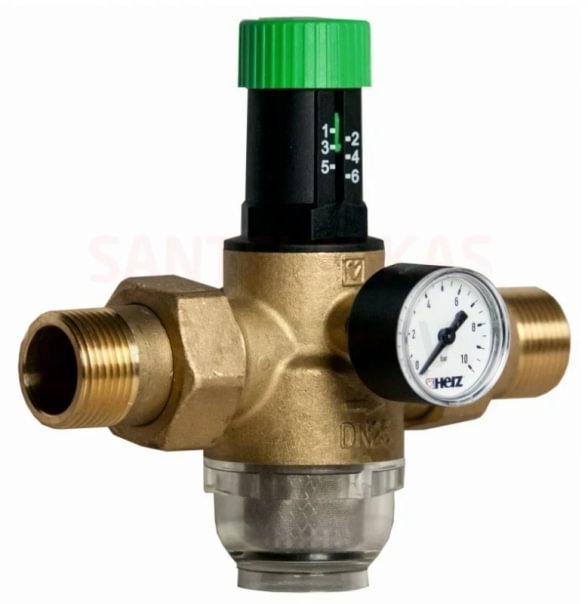
Herz DN25 pressure reducer
- Purpose: stable outlet pressure in a medium-load system
- DN: 25 — mid-range Herz pressure reducer size
- Kvs: ~7-8 m³/h (verify in Herz catalogue)
- Connection: 1" internal thread
Where Herz DN25 pressure reducer is used
Applied on medium-load water supply entries — multi-family buildings (10-20 apartments), small commercial sanitary blocks, heating network make-up lines with higher flow demand. Compared to DN20, DN25 provides lower pressure drop at typical flow and larger control authority when the system experiences occasional short-term peak flows (e.g. morning water demand peaks).
Technical specifications
| Parameter | Value |
|---|---|
| Code | 1268213 |
| Manufacturer | Herz Armaturen |
| Type | Diaphragm pressure reducing valve |
| DN | 25 |
| Connection | 1" internal thread (verify in Herz catalogue) |
| Kvs | ~7-8 m³/h (verify in Herz catalogue) |
| Inlet pressure (max) | up to 25 bar (verify in Herz catalogue) |
| Outlet pressure (adjustable) | 1.5-6 bar (typical Herz range) |
| Max working temperature | up to 80 °C (potable water) |
| Media | Potable water, heating system water |
| Body material | Brass (typically DZR) |
| Diaphragm | Elastomer (EPDM or equivalent) |
Capacity — quick calculation
Water flow: Q = Kvs × √Δp. Example: inlet 6 bar, outlet 3 bar → Δp = 3 bar → Q = 7.5 × √3 ≈ 13 m³/h theoretical maximum.
When to choose Herz DN25 over DN20
- Multi-family buildings 10-20 apartments with shared water supply
- Small commercial sanitary systems (offices with 50-100 staff)
- Heating system make-up lines with elevated flow (when water losses are significant)
- Systems where DN20 causes significant pressure drop at peak flow
B2B delivery and logistics via Amegata.lt
- 24-hour delivery across the EU (from our warehouse in Vilnius)
- Competitive B2B pricing — often below market average
- 30-day payment terms for companies (per contract)
- Free technical consultation on reducer sizing
Official Herz catalogue: herz.eu
Frequently asked questions
When is DN25 required and when is DN20 enough?
Decision: check the maximum simultaneous flow in the system. If it exceeds ~3 m³/h — DN25. If lower — DN20 fits better (smaller, more economical, better control at low flow).
Can two DN20 be piped in parallel instead of one DN25?
Technically yes, but not recommended in practice. Parallel reducers must be synchronised (identical setpoints), and flow between them can fluctuate. A single DN25 or DN32 is simpler and more reliable.
Is DN25 suitable for substation make-up lines?
Yes. Heating make-up lines require a reducer that maintains a stable outlet pressure plus a BA-class system separator (EN 1717 requirement). DN25 suits central boiler rooms with combined building load up to ~500 kW.
Is maintenance required?
A functional test every 3-5 years is recommended: verify the outlet pressure still matches the setpoint and there are no deposits on the diaphragm. Every 10-15 years — replace diaphragm and seat seals (if serviceable) or the full reducer.


