
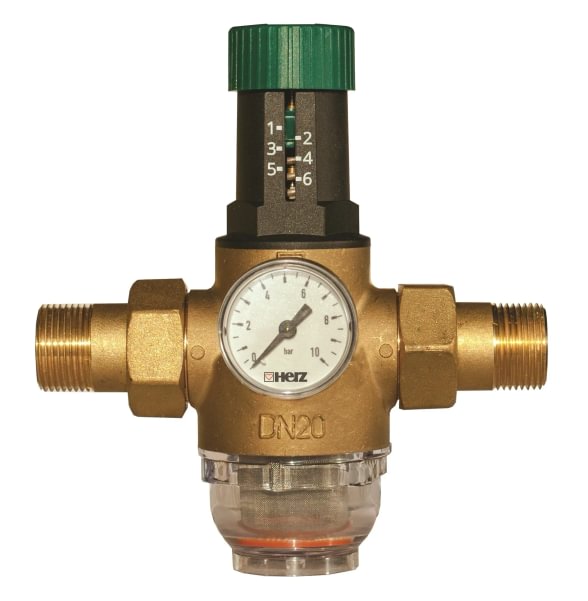
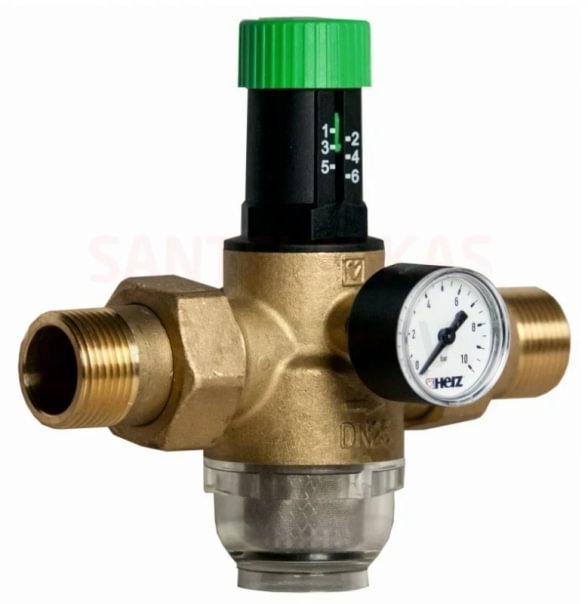
Herz DN32 pressure reducer
- Purpose: stable outlet pressure in a higher-load system
- DN: 32 — higher-load Herz reducer variant
- Kvs: ~12-15 m³/h (verify in Herz catalogue)
- Connection: 1 1/4" internal thread
Where Herz DN32 pressure reducer is used
Applied on higher-load water supply entries — larger multi-family buildings (20+ apartments), commercial premises (shopping centres, hotels), high-rise supply systems with common-managed pressure. In networks with high inlet pressure (>8 bar) DN32 ensures the outlet pressure stays stable during peak flows without significant drop.
Technical specifications
| Parameter | Value |
|---|---|
| Code | 1268214 |
| Manufacturer | Herz Armaturen |
| Type | Diaphragm pressure reducing valve |
| DN | 32 |
| Connection | 1 1/4" internal thread (verify in Herz catalogue) |
| Kvs | ~12-15 m³/h (verify in Herz catalogue) |
| Inlet pressure (max) | up to 25 bar (verify in Herz catalogue) |
| Outlet pressure (adjustable) | 1.5-6 bar (typical Herz range) |
| Max working temperature | up to 80 °C (potable water) |
| Media | Potable water, heating system water |
| Body material | Brass (typically DZR) |
| Diaphragm | Elastomer (EPDM or equivalent) |
Capacity — quick calculation
Water flow: Q = Kvs × √Δp. Example: inlet 8 bar, outlet 4 bar → Δp = 4 bar → Q = 13 × √4 = 26 m³/h theoretical maximum.
When to choose Herz DN32
- Larger multi-family buildings (20+ apartments) with shared water supply
- Commercial premises with significant water consumption (hotels, sanatoriums)
- High-rise buildings (10+ storeys) where common supply carries high flow
- When DN25 causes significant pressure drop at peak flow
B2B delivery and logistics via Amegata.lt
- 24-hour delivery across the EU (from our warehouse in Vilnius)
- Competitive B2B pricing — often below market average
- 30-day payment terms for companies (per contract)
- Free technical consultation on reducer sizing
Official Herz catalogue: herz.eu
Frequently asked questions
How is the reducer DN chosen in a high-rise building?
Requires (1) simultaneous flow calculation per DIN 1988-300, (2) network inlet pressure measurement, (3) required outlet pressure at the lowest floor. DN32 suits buildings with combined load up to ~30-40 fixture units through a single reducer. Larger buildings may require multiple reducers for separate pressure zones.
Can DN32 be used instead of DN25 "for extra margin"?
No. An oversized reducer will not work correctly at low flow — frequent on-off operation instead of proportional, cavitation noise, pressure oscillation. Choose DN by calculation, not by "bigger is better".
Are two reducers in series (cascade) required?
Sometimes. When inlet pressure is very high (>16 bar), a cascade is recommended: first reducer 20 → 8 bar, second 8 → 4 bar. This scheme provides more accurate control and reduces internal loading on the reducer.
Is a separate safety valve required downstream of the reducer?
Depends on the system. In a heating system make-up line the safety valve is already on the heating side (SVW or equivalent). In a potable water system a safety valve is not required if the system is sized to the reducer outlet pressure.


