
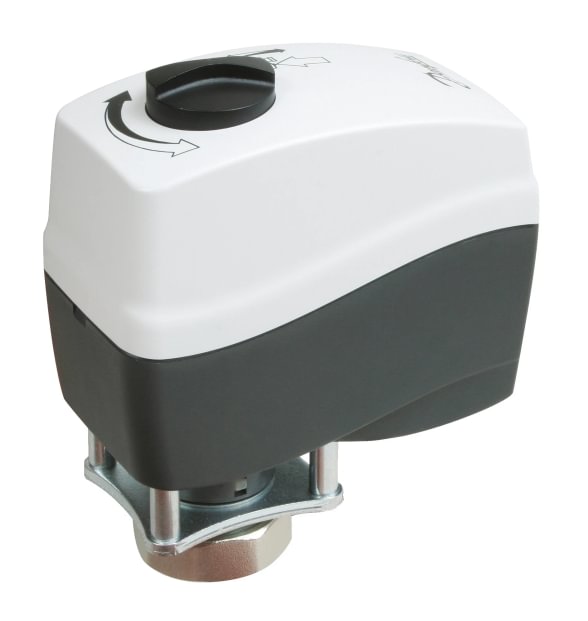
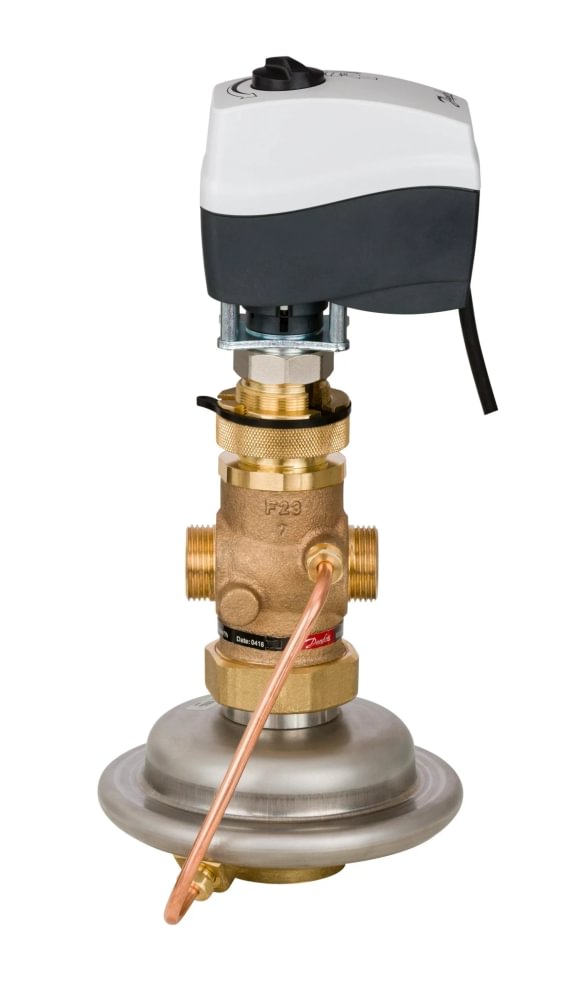
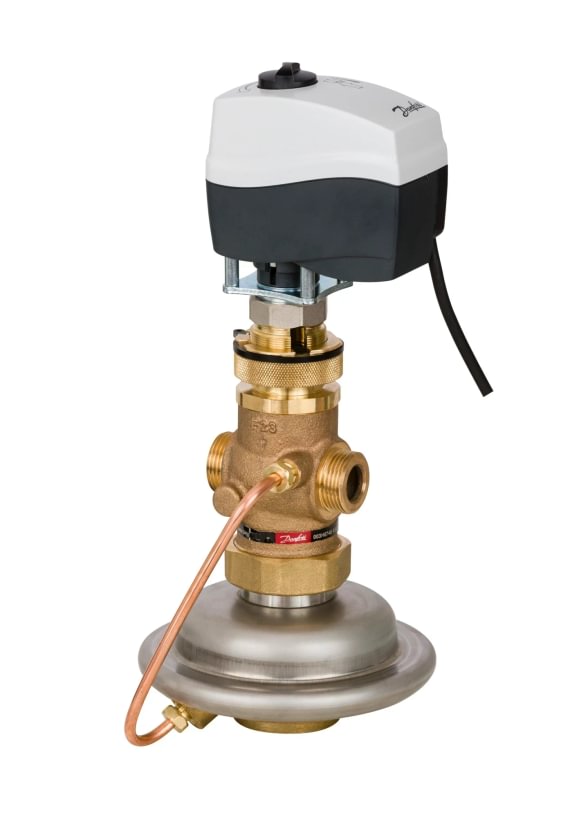
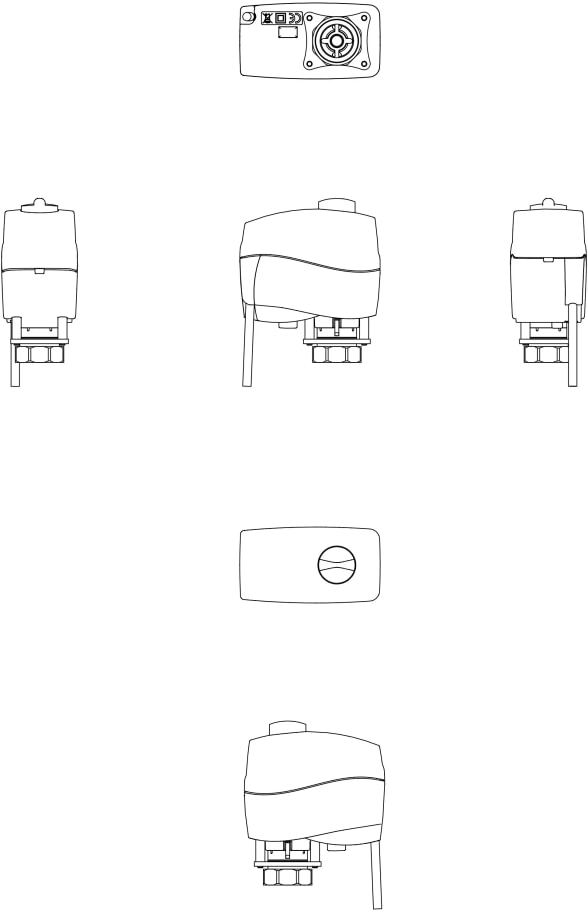
Danfoss AMV 150 precision electric actuator, 230 V, 250 N, 24 s/mm, 5 mm stroke
- Application: low-force zone control valves, precision dosing in heating/cooling loops
- Thrust: 250 N
- Power / control signal: 230 V AC / 3-point
- Running time / IP: 24 s/mm (5 mm stroke = ~120 s) / IP54
Where AMV 150 is used
AMV 150 targets small-DN control valves (typically DN 15–20) and systems where precise, oscillation-free control matters most. The slower 24 s/mm speed allows the controller to command very short pulses producing very small position changes — meaning steadier supply temperature, lower energy waste, and longer valve seat life. Typical installations — zone control in public buildings, radiator branches with TWA-Z heads, dosing in small cooling loops.
Technical specifications
| Parameter | Value |
|---|---|
| Code | 082G3090 |
| Series | Danfoss AMV |
| Model | AMV 150 |
| Thrust | 250 N |
| Running time | 24 s/mm (~120 s full stroke) |
| Stroke | 5 mm |
| Power supply | 230 V AC, 50/60 Hz |
| Power consumption | 8 W |
| Control signal | 3-point (open / close / stop) |
| Fail-safe (spring return) | No |
| Manual operation | Yes |
| Position feedback | No (external potentiometer required) |
| IP class | IP54 |
| Ambient T | 0 … 55 °C |
| Media max T | 150 °C |
| Weight | ~0.39 kg |
When to choose AMV 150
- Small control valves (DN 15–20, low Kvs)
- Zone control demanding very stable temperature
- Radiator branches, TWA-Z heads
- When control quality matters more than speed
- Compatibility: Danfoss VRB 2/VRB 3 (DN 15–20), VRG 2/VRG 3 (DN 15–20), RA-N/RA-C radiator valve adapters; works with Danfoss ECL, Ouman EH/S203 and any 3-point-output controller
B2B delivery and logistics via Amegata.lt
- 24-hour delivery across Lithuania (from our warehouse in Vilnius)
- Competitive B2B pricing — often below market average
- 30-day payment terms for companies (per contract)
- Free technical consultation for low-thrust actuator selection
Official Danfoss catalogue: store.danfoss.com/AMV 150 (082G3090)
Frequently asked questions
Why is AMV 150 slower than AMV 10?
A deliberate design choice for higher positioning precision. At 24 s/mm the pulse resolution (position change per pulse) is ~6× finer than AMV 10 (14 s/mm). Useful where very stable control is required — e.g., radiators with low water flow.
Does AMV 150 have a fail-safe function?
No. If the system needs fail-safe close — consider AMV 13 (300 N with spring) or contact our technical support.
Is AMV 150 suitable for cooling systems?
Yes. Media temperature range covers both heating (up to 150 °C) and cooling (from 2 °C). Ambient range 0…55 °C fits typical substation conditions.
How to choose between AMV 10 and AMV 150?
AMV 10 (300 N, 14 s/mm) — standard small-valve control with medium response. AMV 150 (250 N, 24 s/mm) — when precision is critical and a faster actuator would cause temperature oscillation.
Can the cable be extended?
Yes, up to several tens of metres with 3×1.5 mm². For longer runs — 3×2.5 mm². Power and signal can share the same cable (3-point control uses phase wires with a common neutral).


